Sofas for Renters: Modular, Tool-Free, and Movable
DisclosureThis page contains affiliate links. If you buy through them, we may earn a commission at no extra cost to you.
The useful question is not whether a sofa is called modular. It is whether the parts can get through your current building, whether you can carry them safely, and whether the next layout will still work in the next apartment.
That distinction matters because a modular sofa can be easy to assemble and still be awkward to move. “Tool-free” means you may not need a wrench; it does not mean the boxes are light, the pieces fit every stairwell, or a moving company will treat a sectional as a few small parcels.
This guide compares two ways to make a sofa more adaptable: compact modules that connect into a conventional sofa, and a highly configurable seat-and-side system. We focus on the move itself, not on claiming one is universally more comfortable.
First, measure the move—not just the room
Before choosing a sofa, write down four constraints:
- The narrowest opening on the delivery route. Measure the clear width and height of the front door, elevator, stair landing, and any tight hallway turn. Our delivery route checklist shows the full route to measure.
- The largest box you can handle. Ask the seller for the package dimensions and weight of each carton, not only the assembled sofa dimensions. A 30-inch doorway is not helpful if a carton is 40 inches wide and cannot rotate in the hall.
- Who will carry it. A renter on a third-floor walk-up may need smaller cartons and a second person even when the sofa is modular.
- The next room’s footprint. Measure the likely next living room and save its dimensions with your lease documents. A modular layout only helps if the parts can form a sofa that fits there.
Overall sofa dimensions describe the assembled footprint. They do not tell you how large the shipping cartons are, how each piece turns around a landing, or how much the heaviest module weighs. Get those details from the current product page or support team before paying.
Two different kinds of modular
A sofa made from a few connected modules
Burrow describes its seating as a universal modular system with tool-free assembly; its current product pages also describe taking pieces apart for a move. That can be useful when a loveseat must become a three-seat sofa later, or when you need to carry it through a narrow entry one section at a time.
The practical check is the smallest shipping and carrying unit. Look at the current assembly guide and carton specifications for the exact configuration you are considering. A sofa that arrives as several manageable boxes may be easier to get inside than a one-piece frame, but the assembled arms, legs, and connector hardware still need safe storage during the move. Keep the boxes or record their dimensions if you expect to move again soon.
A seat-and-side system with many possible layouts
Lovesac Sactionals uses standardized seats and sides that can be rearranged into different footprints. That flexibility is most valuable when your room shape changes or when the sofa needs to become an L, a straight row, or a larger arrangement over time. Most listed covers are machine washable, but the care instructions vary by fabric; leather and some specialty covers require different care.
More configuration choices also mean more pieces to count, label, carry, and reconnect. Before buying, build the exact layout you want and confirm the number of seats and sides, the packed dimensions, and the total price. Do not compare a single seat price with a complete sofa price.
The renter’s comparison
| Question | Compact connected modules | Seat-and-side system |
|---|---|---|
| Best reason to choose it | Easier to split an assembled sofa into sections | Many layout changes from a standardized set of parts |
| What to verify | Box dimensions, module weight, connection method | Count and weight of every seat and side; how they connect |
| Moving-day task | Disconnect, wrap, and keep hardware with each module | Label pieces and protect covers and connectors individually |
| Cleaning | Check the specific upholstery care label | Many covers are removable; confirm care for your fabric |
| Common cost trap | Buying an added chaise or upgrade without rechecking total | Adding seats/sides until the set costs more than the room needs |
These are product-system differences, not independent lab results. Current specifications and available configurations can change. Use the seller’s current product and care pages for the model and fabric in your cart.
When movability is the wrong axis
Everything above optimises for one thing: getting the sofa in, and getting it out again. That is the right priority if you expect to move on a one-year lease. It is the wrong priority if your real constraint is that you have one room and a visitor arriving.
Coddle sits on the other side of that trade. It builds sleeper sofas and sleeper sectionals, and its delivery is the opposite of a flat-packed carton: the piece is placed in the room of your choice fully assembled, with the packaging removed. There is no smallest carrying unit to plan around, which means the doorway arithmetic from the top of this page applies to the whole sofa at once, with no second chance.
What you get for accepting that is a number the modular systems do not publish at all — the bed. Published dimensions for the Nova Full-Sized Sleeper Sofa, read on 29 September 2026:
| Nova Full-Sized Sleeper Sofa | |
|---|---|
| Overall | 87 in W × 37 in D × 35.4 in H |
| Seat depth | 24 in |
| Seat height | 19.3 in |
| Opened flat | 75 in × 54 in (full-size) |
| Price | $1,999 |
Two things to take from that table. The 37 in overall depth misses the 34-inch shortlist by three inches, so this is not a sofa for a narrow room — the mattress has to fold up inside the body, and that thickness has to go somewhere. And the opened footprint is a second layout problem, not a detail: 75 in of floor coming out from the wall is most of a small living room, so check it against your walking path before you decide the room can take it.
The line runs from about $648 to $2,499 at the time of writing, so confirm the price and the current dimensions on the product page for the exact model and fabric you are considering.
A room test before you order
Imagine a 12-by-15-foot living room with a sofa against the long wall. Sketch the sofa at the dimensions shown on its product page, then mark the main walking path, the coffee-table gap, and the door swing. If the layout only works when a chair is pushed against a doorway, it is not a workable layout.
Next, sketch the likely next apartment. Test at least two arrangements: the current straight sofa and a shorter arrangement with one module removed. If the smaller setup leaves a useful walkway, modularity has a real future value. If the removed module has nowhere else to go, you are paying to store a piece.
Here is that test with published dimensions. Burrow lists the Range 3-Piece Sofa at 91.5 × 31 in and the Range 2-Piece at 62 × 31 in, with a 29.5 in square ottoman. Put either against the 10-foot wall of a 10 × 11 ft living room, with the entry door on the side wall next to the sofa’s end.
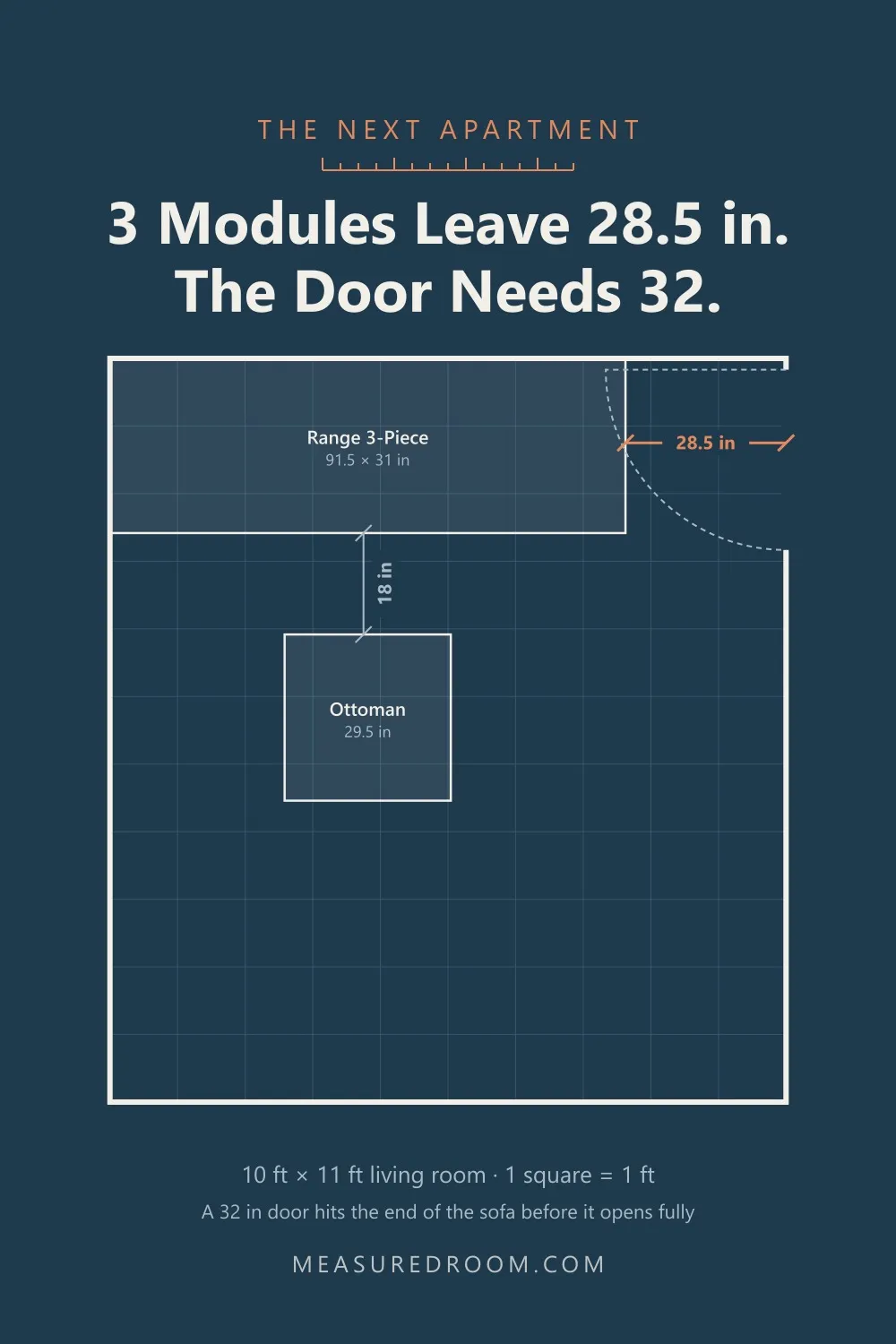
Three modules leave 28.5 in between the sofa and the side wall. That is below the 36 in usually wanted for a main walkway, and a 32 in door swinging into that corner hits the end of the sofa before it opens fully. Take one module out and the same room works:
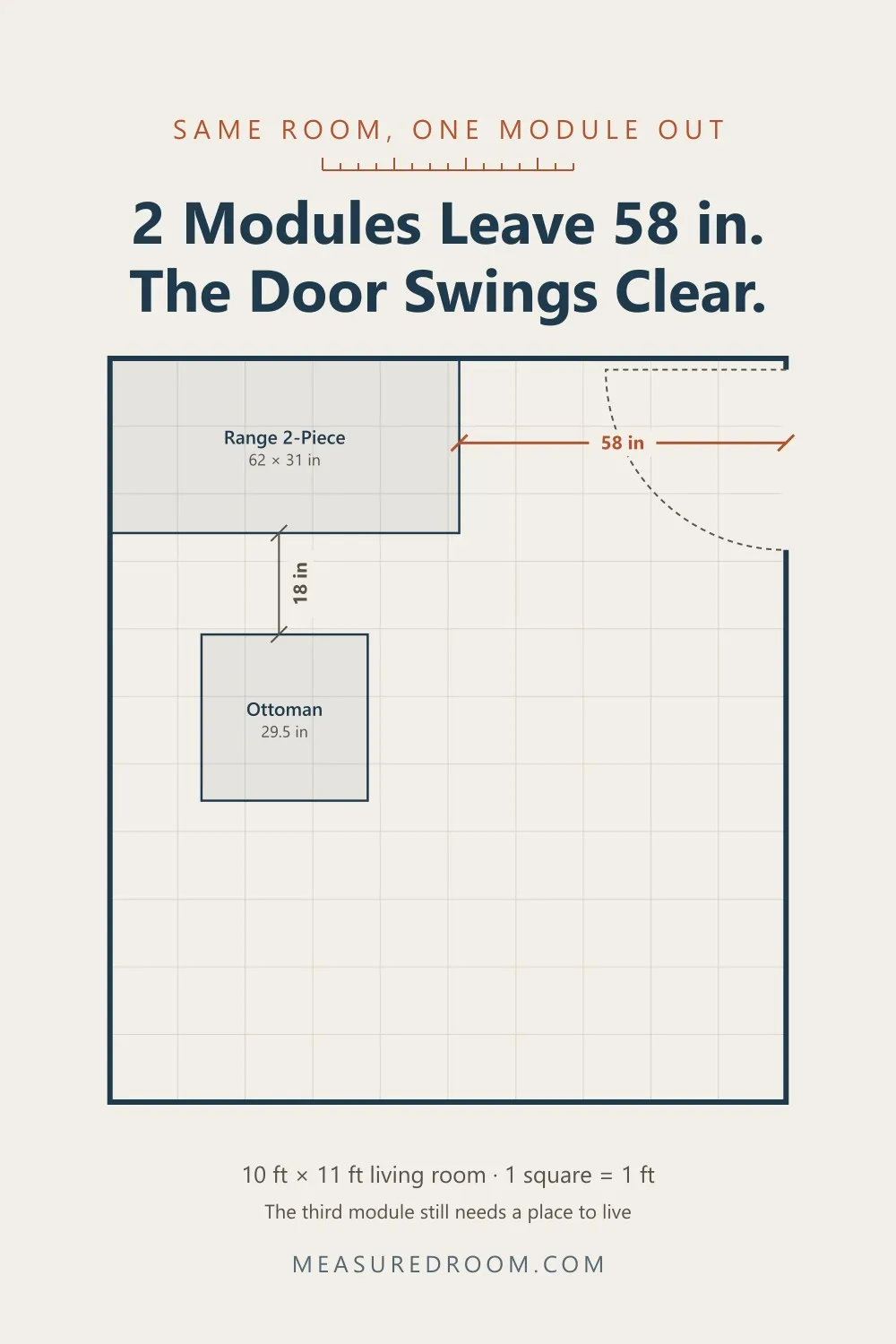
The two-piece version leaves 58 in and the door swings clear. The third module still needs somewhere to live, which is the storage cost described below.
Use the sofa measurement guide to check both the route and the room. Measure the path people actually walk through, not just the empty rectangle in the floor plan.
A quick total-cost test
The advertised price is not the renter’s full cost. Add:
- the configuration you need now, including required sides or connectors;
- delivery and any assembly service;
- the cost of a cover or fabric choice that meets your cleaning needs;
- the likely cost of moving the assembled modules;
- the cost of storing or selling any pieces that will not fit the next home.
Then compare that amount with a conventional sofa that fits your route and room today. If you expect to move only once, a modular system is not automatically cheaper. Its value is the option to change the layout and carry the sofa in parts, not guaranteed savings.
A practical shortlist
Choose compact connected modules if the main problem is a tight delivery route and you want a familiar sofa shape that can be carried in sections. Choose a seat-and-side system if you have a specific reason to change the footprint repeatedly and you are comfortable tracking more components. Choose neither until you have checked box sizes, weights, return terms, and current dimensions.
For a small rental, the best setup is often a two-seat configuration with a separate ottoman rather than a large sectional. It can provide a place to stretch out without permanently taking the floor space needed for a walkway. Our sectional-versus-sofa comparison works through that trade with a measured room plan.
Before checkout
- Save a screenshot or PDF of the exact configuration and its dimensions.
- Confirm whether the modules are sold individually and whether the connection parts are included.
- Read the return policy for large furniture, including pickup fees and the condition required for a return.
- Ask how many cartons will arrive and whether delivery is to the curb, threshold, or room of choice.
- Keep connectors and instructions in a labeled bag attached to the relevant module.
Modularity earns its place when it solves a real constraint: an impossible doorway, a changing floor plan, or a need to split the load on moving day. Measure those constraints first, then decide whether the flexibility is worth the added pieces and price.