Sofas Under 34 Inches Deep: We Checked Six, One Cleared
DisclosureThis page contains affiliate links. If you buy through them, we may earn a commission at no extra cost to you.
Shopping for a sofa by depth sounds like a narrow way to shop, right up until you do the subtraction for your own room. Then it turns out to be the only filter that matters, because depth is the dimension that comes straight out of the space you walk in.
So we set a hard line at 34 in of overall depth and went looking. We took the published dimensions of six sofas across two direct-to-consumer brands, on 17 August 2026, from each brand’s own specification tab.
One line cleared it. That result is the article.

Why 34 inches is the line
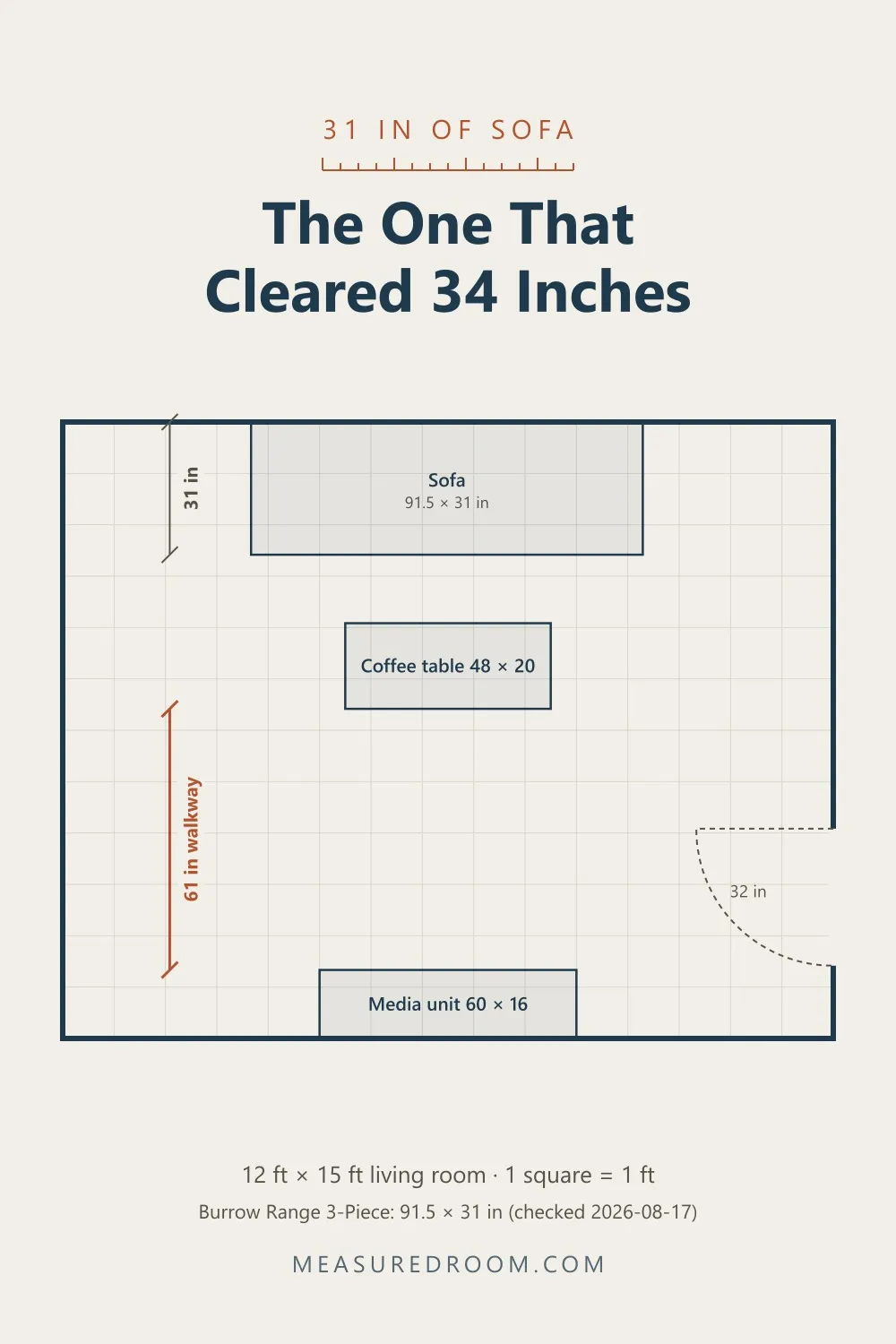
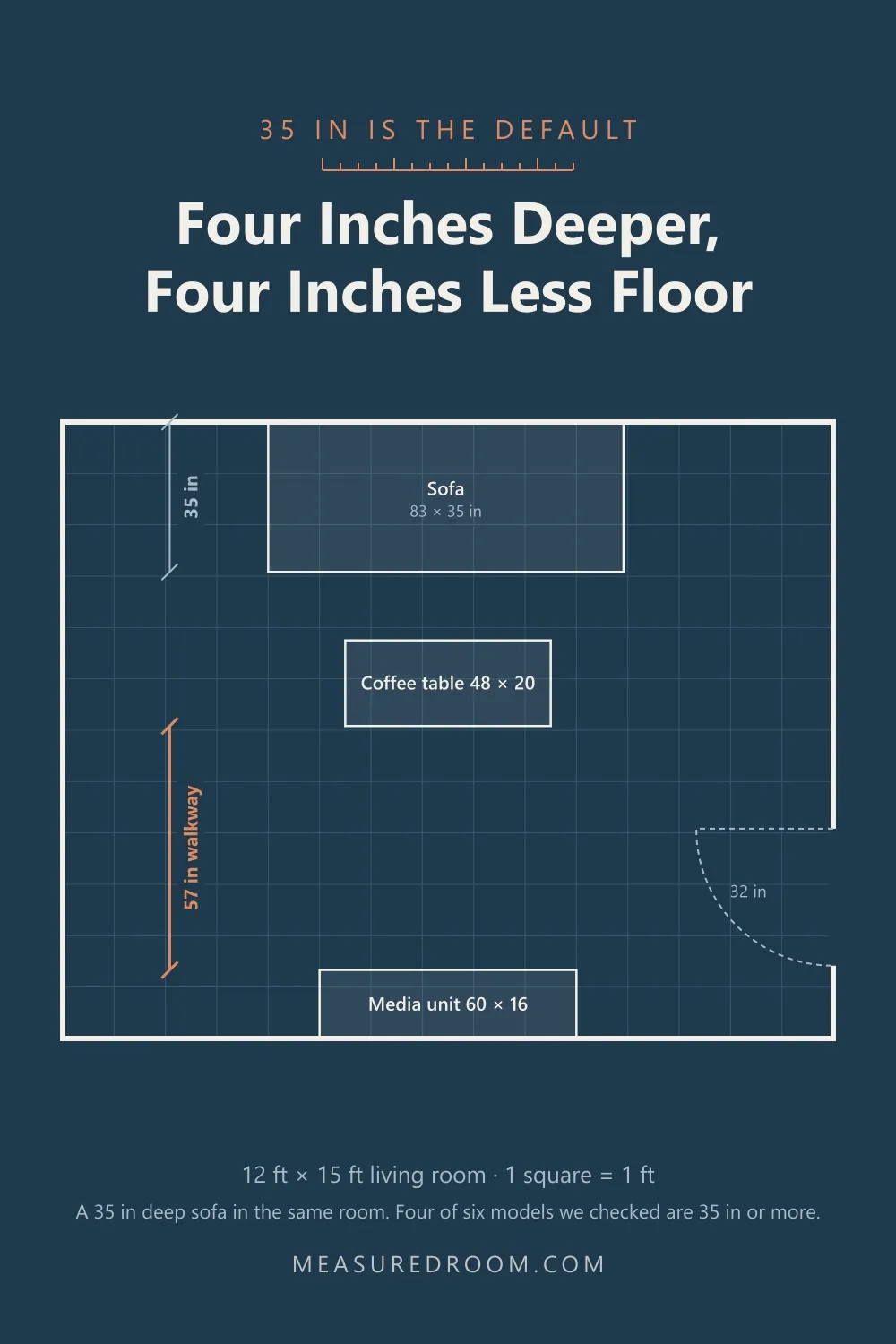
Take a living room 12 ft deep — 144 in. Put the sofa against one wall, leave 16 in to the coffee table, give the table 20 in of its own, and put a 16 in media unit on the far wall. Everything that is left is walkway.
| Sofa depth | Walkway left |
|---|---|
| 31 in | 61 in |
| 35 in | 57 in |
| 38 in | 54 in |
| 44 in | 48 in |
The standard minimum for a main path through a room is 36 in, so all four of those technically pass in a room this size. The line matters more as the room gets smaller, and it matters immediately if the walkway has to pass beside the sofa rather than in front of it. In a 10 ft room the same arithmetic leaves 37 in at 31 inches of sofa, and 33 in at 35 — under the minimum.
Every inch of depth you do not buy is an inch of floor you keep. That is the whole argument.
Overall depth is not seat depth
Two numbers, two jobs.
- Overall depth is the footprint, back frame to front edge. It is what you subtract from the room.
- Seat depth is the usable cushion, front edge to the face of the back cushion. It is what decides how you sit.
They move together, but not by a fixed amount, and the gap is where the surprises live. Of the six sofas below, the shallowest footprint gives up only two inches of seat against a model four inches deeper overall — while the deepest model spends eight extra inches of floor to buy six extra inches of cushion.
How this list was built
Three rules, applied without exception.
- The brand publishes overall depth on the product page. No published number, no entry.
- The brand publishes seat depth as well, so the trade-off is visible.
- Anything over 34 in overall stays in the table, but marked as missed. Hiding the near-misses would make the list look better than the market is.
We have not sat on these. This is a comparison of published specifications, not a comfort review — the numbers below are the manufacturer’s own, read on 17 August 2026. Verify on the product page before you order, because dimensions change between production runs.
The six
| Sofa | Overall depth | Seat depth | Width | Height | Verdict |
|---|---|---|---|---|---|
| Burrow Range 2-Piece | 31 in | 21 in | 62 in | 28 in | Clears |
| Burrow Range 3-Piece | 31 in | 21 in | 91.5 in | 28 in | Clears |
| Article Ceni 83“ | 35 in | 23 in | 83 in | 31 in | Missed by 1 in |
| Burrow Nomad | 35 in | 22 in | 85 in | 33 in | Missed by 1 in |
| Article Sven 88“ | 38 in | 24 in | 88 in | 34 in | Missed by 4 in |
| Burrow Union 3-Seat | 39 in | 27 in | 100 in | 31.5 in | Missed by 5 in |
Two things fall out of that table.
Thirty-five inches is the default. Two of the six land exactly there, and they are the two you would reach for first — a mid-century three-seater and a modular sofa built for apartments. Neither is a deep lounging sofa. Thirty-five is simply where a normal sofa sits.
The Range line is the outlier, and it is four inches shallower than the default. In the room above, that is the difference between 61 in and 57 in of walkway — and in a smaller room, the difference between passing and not.
What you give up at 31 inches
A 21 in seat is an upright seat. Feet on the floor, back against the cushion, easy to stand up from. It is not a sofa you stretch out on without adding a cushion behind you, and if you are tall it will feel short.
Compare the band it sits in:
| Seat depth | Sits like | In this table |
|---|---|---|
| 20–22 in | Upright | Range (21), Nomad (22) |
| 22–24 in | The default | Ceni (23), Sven (24) |
| 24 in and over | Lounge | Union (27) |
Those three bands are the whole usable range, and which one you belong in depends on your leg length rather than on the sofa — we took that apart in seat depth explained.
Notice that the Union buys its 27 in seat with 39 in of floor — eight inches more than the Range for six inches more cushion. That is an honest trade if you have the room, and an expensive one if you do not.
There is a second thing you get at 31 inches, and it has nothing to do with sitting: the Range ships as separate pieces in ordinary boxes and clicks together without tools. If your problem is a narrow doorway or a tight stair turn rather than floor area, that matters more than any dimension in the table.
Before you order
- Measure the narrowest opening on the delivery route, then compare it against the sofa’s box diagonal — the method is in our doorway guide. A sofa that ships in boxes sidesteps this entirely.
- Check the return window and who pays for pickup. On a large item this is the real cost of being wrong, and it differs by brand.
- Check the delivery type: curbside, threshold, or in-room. They are not the same, and only one of them puts the sofa where you want it.
If you only take one number away: 35 inches is normal, and under 34 is rare. If your room needs the shallow end, you are not shopping a whole market. You are shopping a short list.