Seat Depth Explained: 20 in vs 24 in
DisclosureThis page contains affiliate links. If you buy through them, we may earn a commission at no extra cost to you.
There are two numbers on a sofa spec tab with the word depth in them, and they answer completely different questions. One comes out of your floor. The other decides whether you can sit back without your feet leaving the ground.
We spent the last article on the first one. This is the second.
The number that decides how you sit
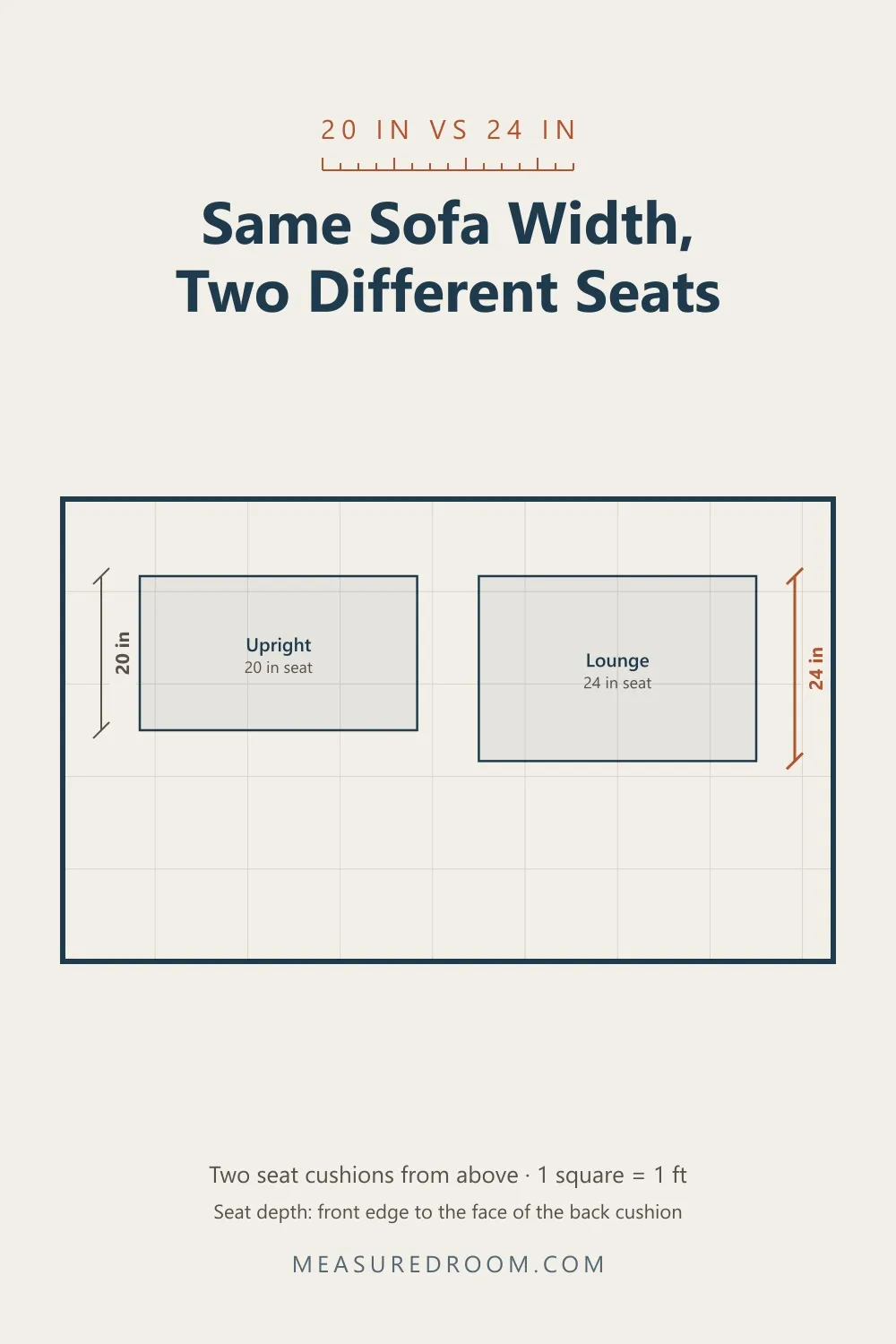
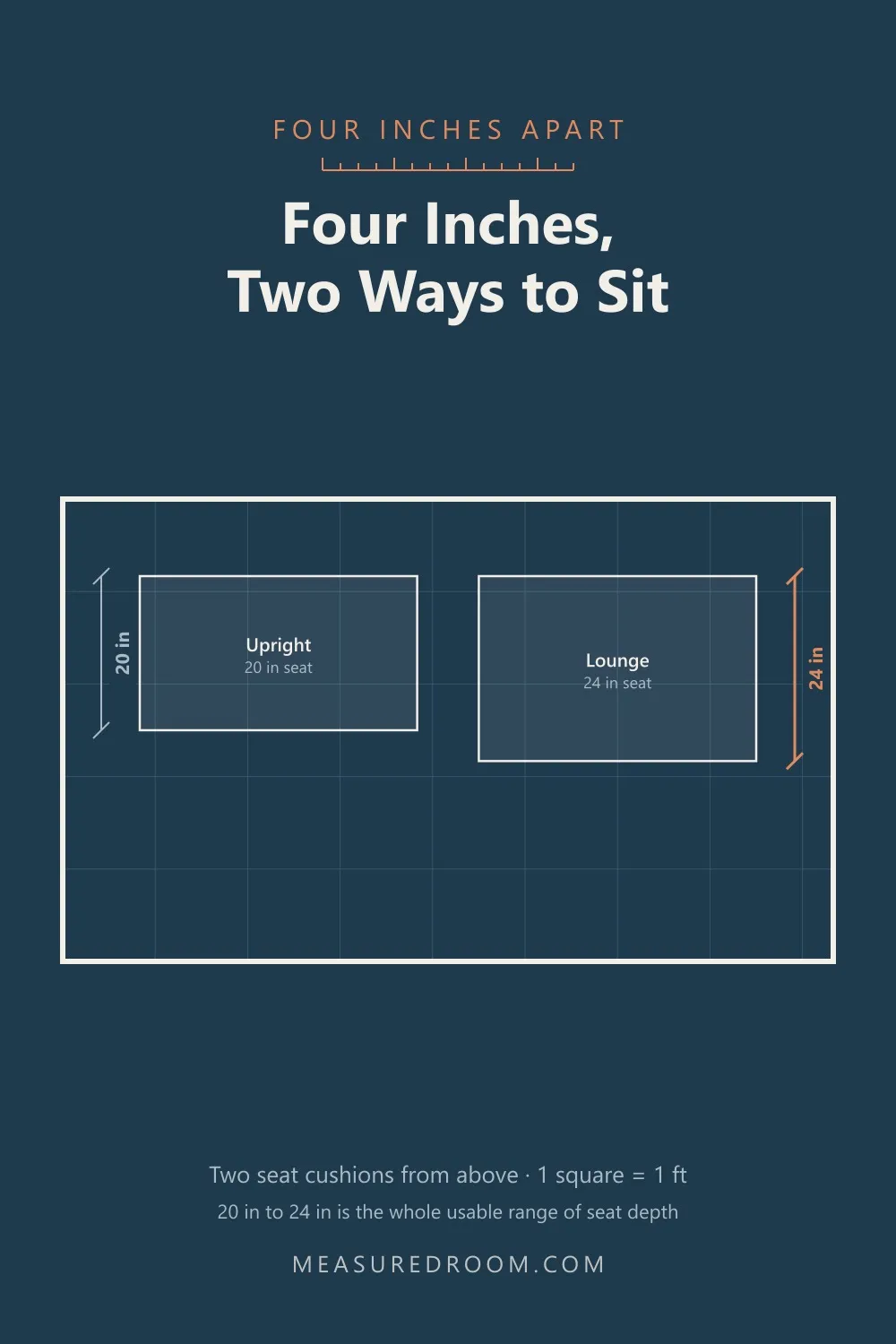
Seat depth is the usable cushion: front edge of the seat to the face of the back cushion. Nothing else. Not the frame, not the arms, not the back.
Overall depth is the footprint: back frame to front edge, the whole object seen from above. That is the number you subtract from the room, and we worked through that subtraction in the shallow sofa shortlist.
They share a word and they move together, but there is no fixed relationship between them. A sofa can spend its extra inches on a thick back cushion, a rolled arm, or a deep seat, and the spec tab prints one 35 in either way. Which is why a sofa that fits the room perfectly can still be the wrong sofa to sit on.
Why height changes the right number
The test is what happens behind your knees.
Sit all the way back, so your spine meets the back cushion. If the front edge of the seat stops short of the back of your knees, your thighs are unsupported and you will slide forward within a minute. If it runs past them, the edge presses into the back of your knees and your feet come off the floor.
Between those two failures there is a band that works, and the band moves with leg length. This is the part people get wrong: they read that 24 in is comfortable, buy a 24-inch seat at 5’2“, and end up perching on the front third of a sofa they paid two thousand dollars for. Nobody is wrong about the number. They are comparing it against the wrong leg.
So the right way to read a seat depth is not is this deep enough but deep relative to whom. Shorter legs want the shallow end. Longer legs want the deep end. Everyone else is somewhere in between — and the distance between the ends is only about four inches.
What 20, 22 and 24 inches sit like
Four inches does not sound like a range. It is the whole range.
| Seat depth | Sits like | Suits | Trade-off |
|---|---|---|---|
| 20–22 in | Upright | Shorter legs; anyone who reads, eats or works on the sofa | Not a lying-down sofa. Tall sitters end up with knees higher than hips |
| 22–24 in | Default | Most people, most of the time | Comfortable for everyone, ideal for nobody |
| 24 in and over | Lounge | Longer legs; feet-up television watching | Shorter sitters cannot reach the back cushion without a pillow behind them |
The middle band is where most brands live, and that is not laziness. It is the depth that offends the fewest customers, which is the right thing for a manufacturer to build and not necessarily the right thing for you to buy.
The two ends are the interesting ones. Upright is a posture, not a compromise. If you sit on your sofa the way you sit on a chair — upright, feet down, laptop or plate in front of you — a 21-inch seat is better at that job than a 27-inch seat, at any height. And Lounge is a commitment. A 27-inch seat is a bed with a back on it, and it is genuinely awkward to sit upright on, because upright is not what it is for.

The trade-off overall depth hides
Here is the part that is hard to see from a product page. Two sofas, same published overall depth, different seats:
| Sofa | Overall depth | Seat depth | Arms |
|---|---|---|---|
| Article Ceni 83“ | 35 in | 23 in | Slim, angled |
| Burrow Nomad | 35 in | 22 in | Squared, upholstered |
Both take exactly the same 35 in out of your room. One gives you an inch more cushion for it. These are the manufacturers’ own published figures, read on 17 August 2026 as part of the six-sofa comparison — check the current product page before you order, because dimensions change between production runs.
An inch is not much. The point is not the inch, it is that the room number told you nothing about the seat number. Widen the sample and the gap gets larger. In that same table, the Burrow Union 3-Seat spends 39 in of floor to deliver a 27 in seat, while the Burrow Range spends 31 in to deliver 21 in. Eight extra inches of room, six extra inches of cushion. Two of those inches went into frame and arms, and you never sit on them.
There is one direction this is fixable and one it is not. You can make a seat shallower by adding a bolster or a lumbar cushion against the back — people do this constantly, and it works. You cannot make a seat deeper. There is nothing to add. If the seat is too shallow for your legs, that is the sofa you bought.
Which gives a rule for the awkward case: when you are genuinely between two bands, err deep.
How to check before you order
Find out whether the brand publishes it at all. Overall depth is on every product page. Seat depth is not. If a brand gives you width, depth and height and stops there, you cannot evaluate that sofa against your own body, and no amount of reading reviews will substitute for the missing number. That absence is a fact about the listing, and it is worth treating as one.
Watch for modular sofas, where the number is per module. Lovesac Sactionals are the clearest case: the sofa is assembled from Seat blocks and Side pieces, so the depth you sit on is a property of the configuration rather than of the product. On its Sactionals page, read on 3 September 2026, Lovesac publishes module dimensions — a Standard Seat at 35 in long by 29 in wide by 18 in high, and a Deep Seat described as six inches deeper, the same block turned — but it does not publish a seat depth measured to the face of the back cushion. With a modular sofa you are choosing a footprint per block, and finding out the seat depth when it arrives, unless you ask first. Ask first.
Look at the front edge, not just the number. A rolled or waterfall front edge lets the cushion fall away under your knees, so it behaves as slightly shallower than it measures and is far more forgiving at the deep end. A hard square edge behaves as exactly what it measures, and is unforgiving. This is why two sofas with the same published seat depth can feel a size apart, and it is the one thing on this page you can only judge from a photograph or in person.
Then measure yourself, once. Sit all the way back in a dining chair with your feet flat on the floor. Measure from the back of your knee to the chair back. That figure, minus an inch or so of clearance, is the seat depth your legs are asking for. It takes thirty seconds and it beats every rule of thumb on the internet, including the ones above.
Picking your number
The order matters, because doing it the other way round is how people end up with a sofa that fits and does not work.
- Start with the body. Measure once, pick a band: Upright, Default, or Lounge.
- Then filter by the room. Take your overall depth ceiling — the 34-inch arithmetic is one way to set it — and drop everything above it.
- Then look at what is left. If the two constraints leave nothing, the room wins. You can add a cushion to a shallow seat. You cannot add floor.
Use case maps onto the bands cleanly, too. If the sofa is where guests sit and where you eat, go Upright — you will be getting up off it several times an evening, and a 21-inch seat is easy to stand up from. If the sofa is where the evening happens, go Lounge and accept the floor it costs.
Two numbers on the spec tab. One is about the room, one is about you, and the room one is the only one anybody checks.