Mattress on Floor: How Low Is Too Low, and What Goes Next to It
DisclosureThis page contains affiliate links. If you buy through them, we may earn a commission at no extra cost to you.
A mattress on the floor looks like the simple option. No frame to build, nothing to buy, and the room looks bigger.
It also takes every height decision you had and folds them into one. A bed on a frame is three numbers added together. A mattress on the floor is one: its own thickness. That number decides how hard it is to get up, what can stand beside the bed, and which sheets still fit.
Here is what each of those comes to. There is also one thing the height numbers will not tell you, which is that the company whose mattress we are measuring advises against doing this at all. We get to that below.
The stack, with and without a frame
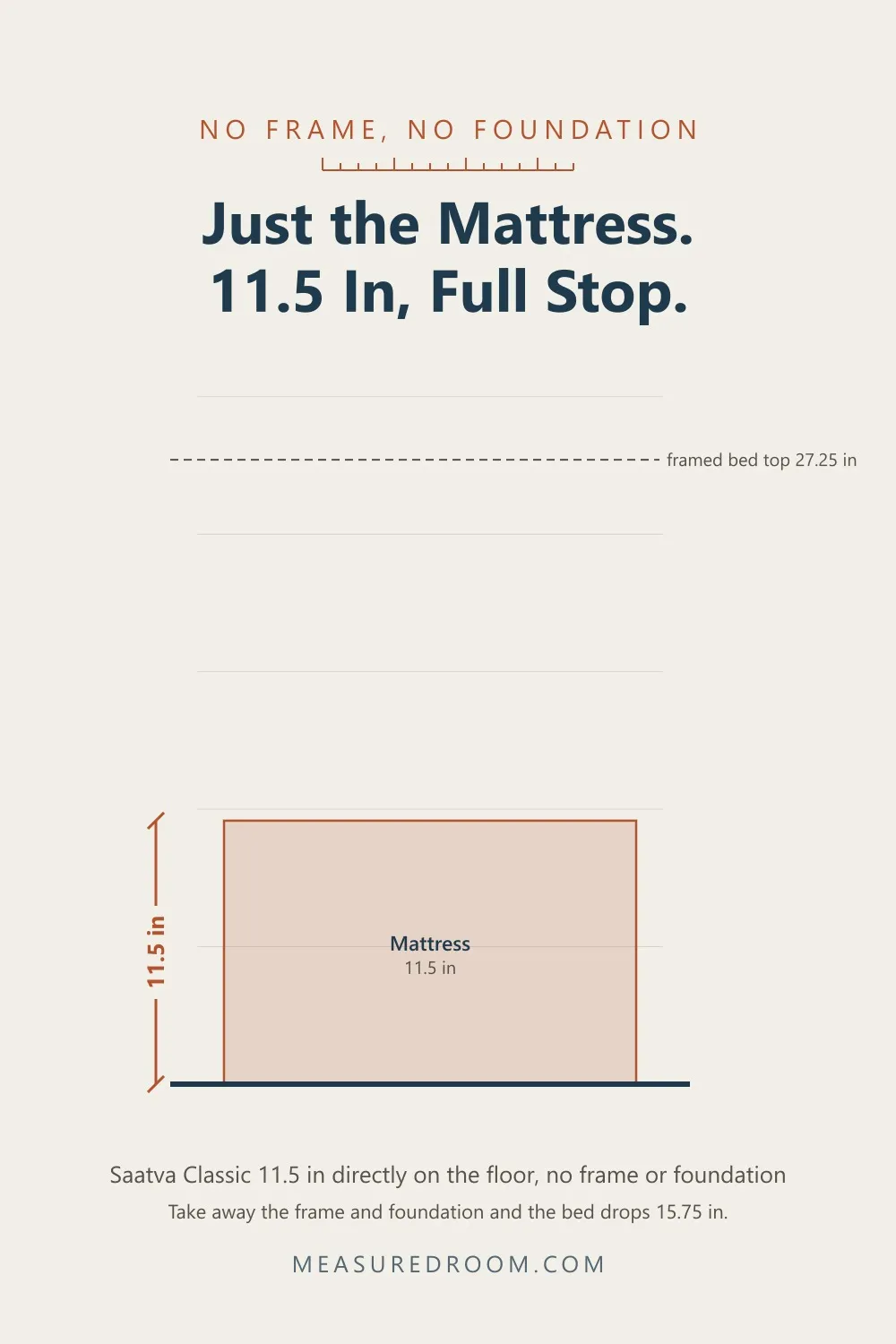
We use the Saatva Classic because it is sold in two published heights, 11.5 in and 14.5 in, and the same company publishes its foundation heights. The 7 in frame is the “standard” frame Saatva’s own bed skirt guidance refers to, the same one we used in mattress sizes and bed frame height. Figures read on 3 November 2026.
| Setup | Frame | Foundation or bunkie | Mattress | Top of mattress |
|---|---|---|---|---|
| On the floor | none | none | 11.5 in | 11.5 in |
| On the floor, thicker mattress | none | none | 14.5 in | 14.5 in |
| Frame + 2 in bunkie board | 7 in | 2 in | 11.5 in | 20.5 in |
| Frame + low foundation | 7 in | 4.75 in | 11.5 in | 23.25 in |
| Frame + standard foundation | 7 in | 8.75 in | 11.5 in | 27.25 in |
Going from the last row to the first drops the top of the bed by 15.75 in. Nothing else in the room moves to meet it, which is what the rest of this article is about.
How low is too low: the getting-up test
A dining chair seat sits at 17 to 19 inches. That range is what furniture settled on for sitting down and standing up many times a day, so it is the fair comparison for the edge of a bed.
| Top of the bed | Below a chair seat by |
|---|---|
| 11.5 in | 5.5 to 7.5 in |
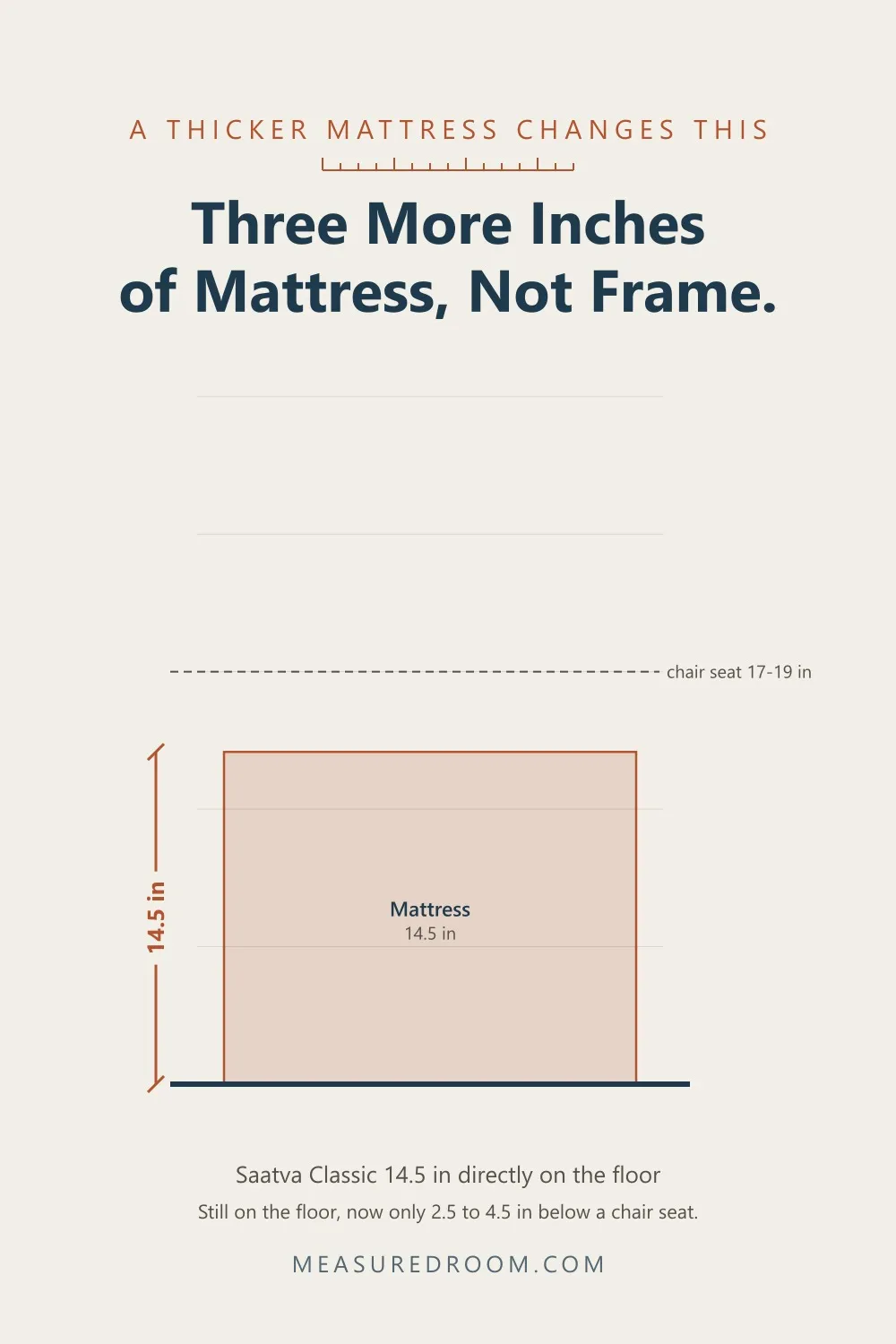
| 14.5 in | 2.5 to 4.5 in |
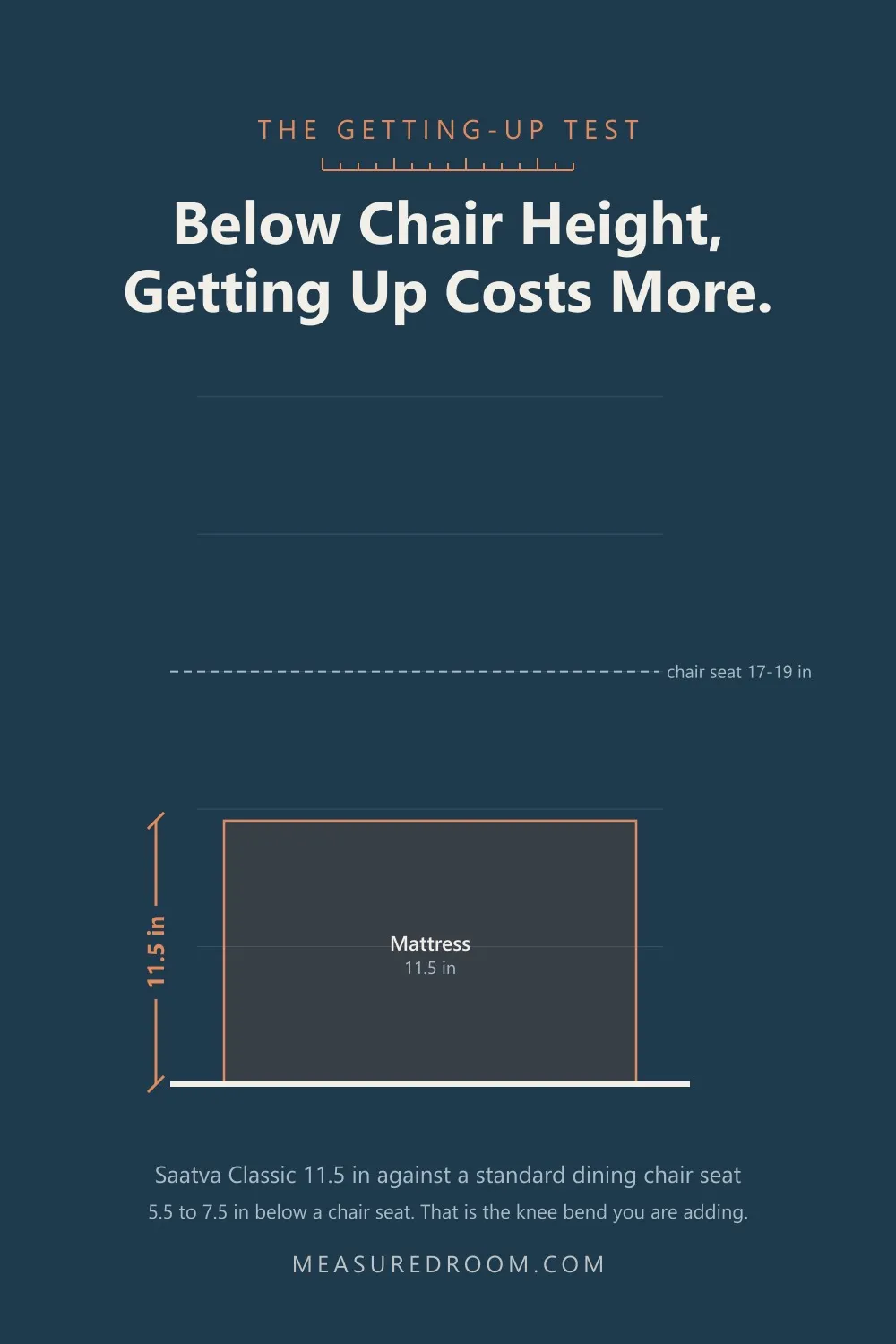
There is no number at which a low bed becomes wrong. A healthy 25-year-old gets up from 11.5 inches without noticing. What the table measures is how much further your knees and hips travel than they do from a chair, every morning, half asleep.
The thicker mattress buys back three inches, and it is the only thing that can. With no frame, thickness is the only control you have left.
Both Saatva and the Sleep Foundation say the same thing about mobility: a floor mattress is harder to get in and out of, and it gets harder if your mobility is limited. If anyone using this bed has knee or hip trouble, test it before you commit. Sit on a 12 inch step or a stack of books and stand up without using your hands. If that is unpleasant now, a frame is the cheaper fix.
Why your nightstand doesn’t work anymore
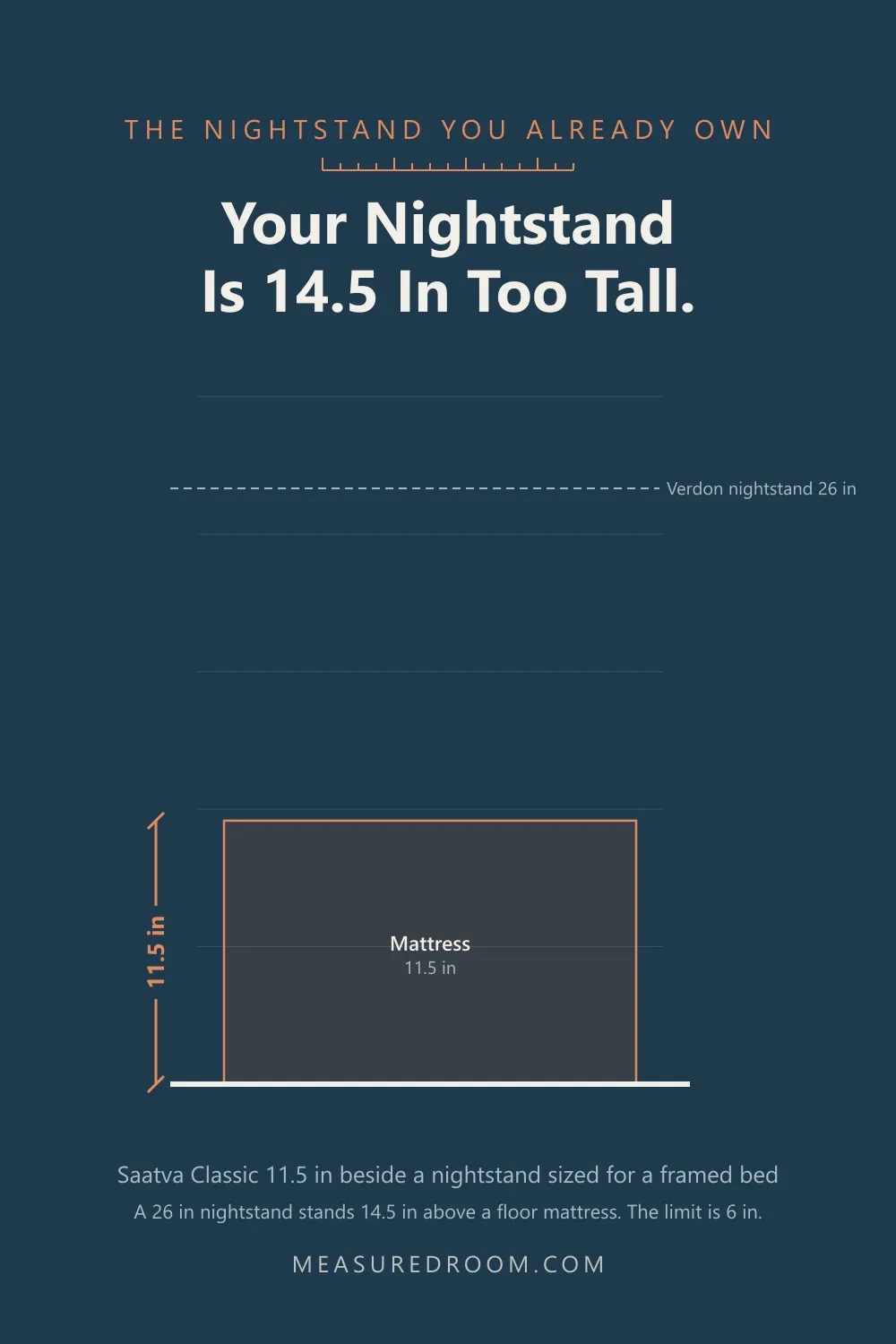
The rule from nightstand height vs the top of the mattress: level with the top of the mattress, or up to 2 inches below, with 6 inches either way as the outer limit. Run that against a floor mattress.
| Top of the bed | The target | The outer limit |
|---|---|---|
| 11.5 in | 9.5 to 11.5 in | 5.5 to 17.5 in |
| 14.5 in | 12.5 to 14.5 in | 8.5 to 20.5 in |
Now the four nightstands in Saatva’s range, measured the same way:
| Nightstand | Height | Above an 11.5 in bed | Above a 14.5 in bed |
|---|---|---|---|
| Lyse | 21.7 in | 10.2 in | 7.2 in |
| Acadia | 23.5 in | 12 in | 9 in |
| Calan | 24 in | 12.5 in | 9.5 in |
| Verdon | 26 in | 14.5 in | 11.5 in |
Every one of them is past the outer limit, at either mattress height. Even the shortest stands more than 7 inches above the thicker mattress. This is not a Saatva problem. A nightstand is built to sit beside a bed on a frame, so when the bed comes down 15.75 in and the nightstand stays where it is, the match is the first thing to break.

What actually sits level with a floor mattress
Stop searching for “nightstand”. Nothing sold under that word we have measured comes close. What you want is a surface 9.5 to 11.5 in high for the thinner mattress, or 12.5 to 14.5 in for the thicker one, and that lives in other categories:
- Floor trays and tray tables on short legs. Start here for the thinner mattress. Read the height.
- Low stools and low side tables. Start here for the thicker mattress. Some are too tall for either, so read the height.
- A stack of something flat and heavy. Two crates or a pile of hardcovers is honest, adjustable and free.
We are not naming a product here, because we have not found one we can vouch for with a published height. The method matters more anyway: filter by height, ignore any listing that does not print it, and hold a tape measure beside the mattress you actually have before you order.
The trade-off the thickness spec doesn’t show
Here is the part that no height table covers. Air can’t get under a mattress on the floor.
Saatva’s own article on the subject is blunt about it, and it is worth reading from a company that would sell you the mattress either way. It says floor placement can cut off airflow so that sweat and moisture build up, with mold and mildew possible as a result, and it says putting a mattress on the floor “risks voiding your mattress warranty.” The Sleep Foundation gives the same warning about moisture, especially in warm or humid rooms.
Check the warranty before you do this. Saatva’s warranty page sets out what a frame or platform has to be, and it does not mention the floor either way. Its product page lists a foundation, box spring, bunkie board or platform as the supports for the Classic. The floor is not on that list. So ask Saatva in writing, or assume you have no cover, and do the same with any other brand.

If you are going ahead anyway, the advice from those two sources comes down to this:
- Air it out. Saatva says to prop the mattress against a wall at least weekly.
- Clean and dry the floor under it. Saatva says at least every four weeks. Let the floor dry completely before the mattress goes back.
- Prefer hardwood or tile to carpet. Carpet can hold moisture.
- Look underneath each time. Moisture, dust and bugs are all easier to catch early.
Both sources also suggest a thin barrier of plywood, foam or cardboard on a hard floor. That takes the mattress off the bare floor, but a solid sheet is not airflow, so it does not replace the airing out.
A word on what a mattress pad does and doesn’t do here. Sleep & Beyond’s myPad is a 0.5 in washable wool pad, and the maker says the wool wicks moisture away from you. That is a claim about the top of the mattress, where you sweat. It may well make a low bed more comfortable, and you can wash it, which you cannot do to a mattress. It does nothing for the underside, which is where the floor causes the problem.
If what you want is the low look, you may not need the floor. A 7 in frame and a 2 in bunkie board put the same mattress at 20.5 in, which is the lowest setup in the table that keeps it off the ground. It is still well below the 27.25 in of a full stack, and air can move under it again. For a queen or larger, Saatva’s warranty wants a frame with center support, so check that when you pick one.
Before you buy: thickness, topper and the sheet pocket
If the mattress is going on the floor, thickness is the height decision, so make it on purpose. On a frame, the thicker Classic is a matter of feel. Here it also does the job the frame would have done.
You might think a topper could finish the job for free. Add one and you meet the sheet.
| Stack on the floor | Total | Against a 16 in sheet pocket |
|---|---|---|
| 11.5 in + 2 in topper | 13.5 in | fits |
| 11.5 in + 3 in topper | 14.5 in | fits |
| 14.5 in + 2 in topper | 16.5 in | 0.5 in over |
| 14.5 in + 3 in topper | 17.5 in | 1.5 in over |
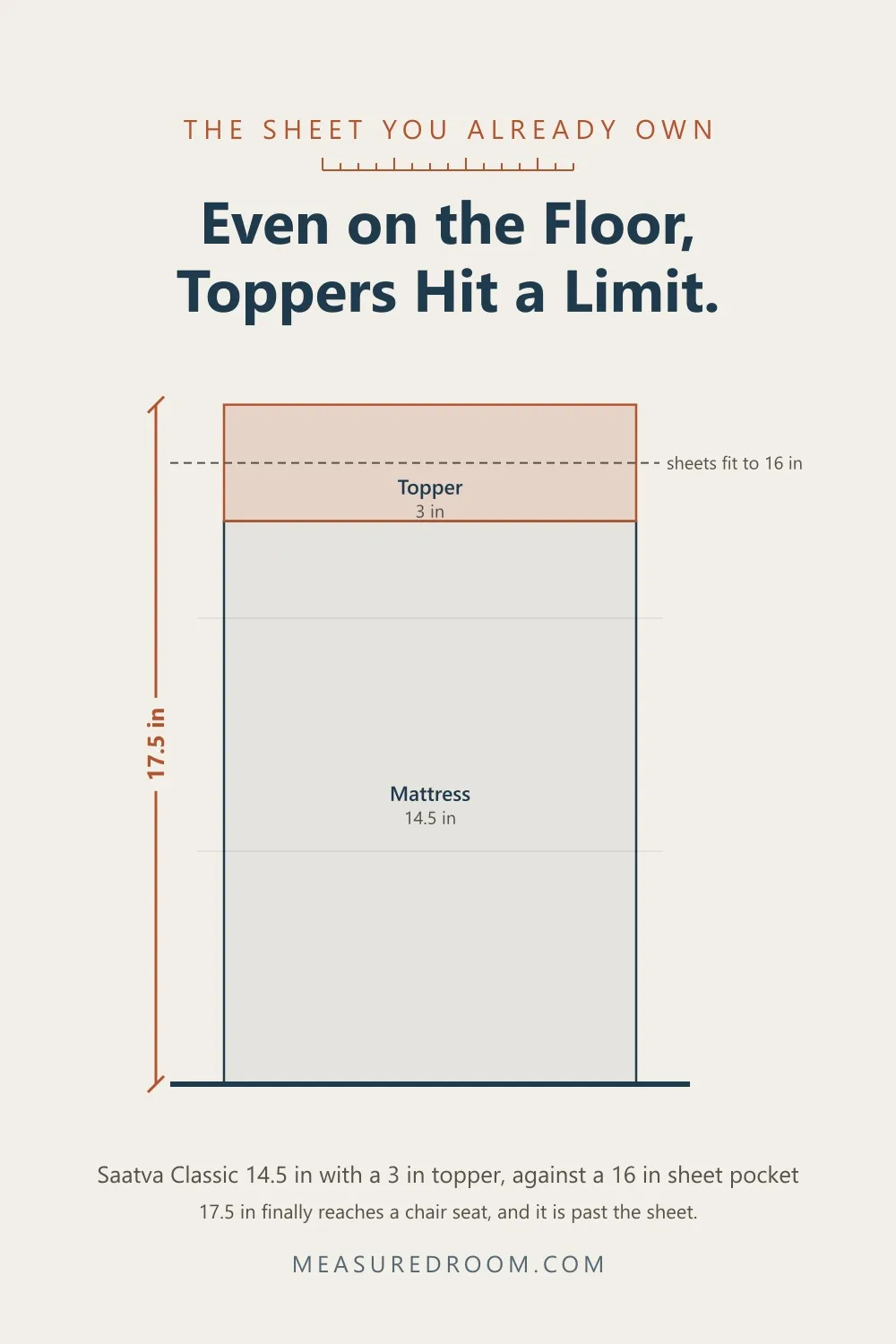
Only the last row gets you to chair height with no frame, and it is the one that overflows Saatva’s “up to 16 in” sheets. Sleep & Beyond’s mySheet is rated to mattresses up to 18 in, which clears 17.5 in by 0.5 in. That will go on, but it is tight, and the usual advice is to leave 1 to 2 inches. Look at it the other way, too: a frame and bunkie board solve the same height problem with no topper at all.
Mattress on floor checklist
13 items · 4 categories
Mattress on floor checklist — measuredroom.com
Measure in inches. With no frame, the mattress thickness is the top of the bed.
Before you order
- Ask the maker, in writing, whether floor use affects the warranty
- Test getting up from a 12 in step without using your hands
- Choose the thickness: 11.5 in is 5.5 to 7.5 in below a chair, 14.5 in is 2.5 to 4.5 in below
- Floor type: hardwood or tile, not carpet
Beside the bed
- Target height: the top of the mattress, down to 2 in below
- Outer limit: 6 in either way
- Skip anything sold as a nightstand unless the height is printed and it fits
Sheets
- Add mattress and topper. That is the number to fit.
- Pocket depth 1 to 2 in more than that total
- Look for the depth in inches, not the words "deep pocket"
The routine
- Prop the mattress against a wall at least weekly
- Clean and fully dry the floor under it at least every four weeks
- Check underneath for moisture, dust and bugs each time
If you take one thing away: a mattress on the floor doesn’t remove the height decision. It moves all of it into the thickness you order, and it adds a warranty question that a frame never asks. Answer that one first.