Mattress Sizes and Bed Frame Height, Worked Out
DisclosureThis page contains affiliate links. If you buy through them, we may earn a commission at no extra cost to you.
You can get the mattress size right and still get the bed wrong.
Size is the easy part — it is standardised, and a queen is a queen wherever you buy it. Height is not standardised, is not published as a total, and is the number that decides whether the bed is comfortable to get out of and whether your sheets still fit.
A bed is three things stacked: a frame, a foundation, and a mattress. Each one is sold separately, each publishes its own height, and no page anywhere adds them up for you. So let’s do that.
The sizes, which are the easy part
These are standard across the industry. Saatva publishes the same figures everyone else does, which is exactly what you want from a standard.
| Size | Mattress |
|---|---|
| Twin | 38 × 75 in |
| Twin XL | 38 × 80 in |
| Full | 54 × 75 in |
| Queen | 60 × 80 in |
| King | 76 × 80 in |
| California King | 72 × 84 in |
Two things worth noticing before you move on. A king is 16 inches wider than a queen but exactly the same length. And a California King is narrower than a king — it trades four inches of width for four inches of length, which is the right swap only if someone in the bed is tall.
The stack, which is the hard part
Here is a real combination, using published numbers read on 21 August 2026.
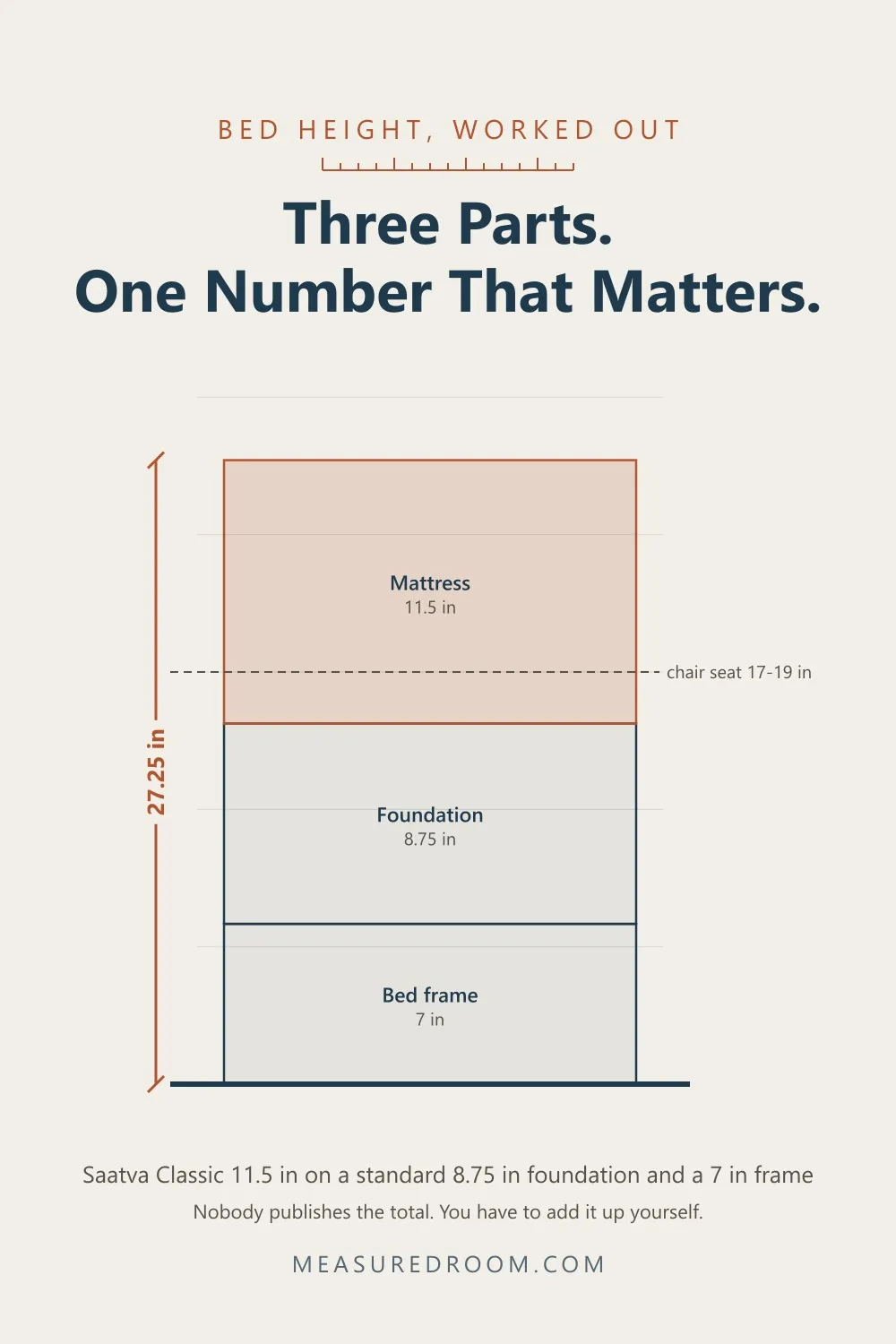
| Part | Height |
|---|---|
| Bed frame | 7 in |
| Foundation | 8.75 in |
| Mattress (Saatva Classic, lower profile) | 11.5 in |
| Top of the mattress | 27.25 in |
Every one of those is a real published figure. Saatva sells the Classic in 11.5 in and 14.5 in. It sells foundations in 8.75 in and 4.75 in, plus a 2 in bunkie board. And the 7 inch frame is Saatva’s own reference point — its guidance on bed skirts notes that a standard skirt drop of 14 to 15 inches suits an 8.75 in foundation on “a standard 7 in bed frame.”
Now swap parts and watch what happens.
| Frame | Foundation | Mattress | Top of mattress |
|---|---|---|---|
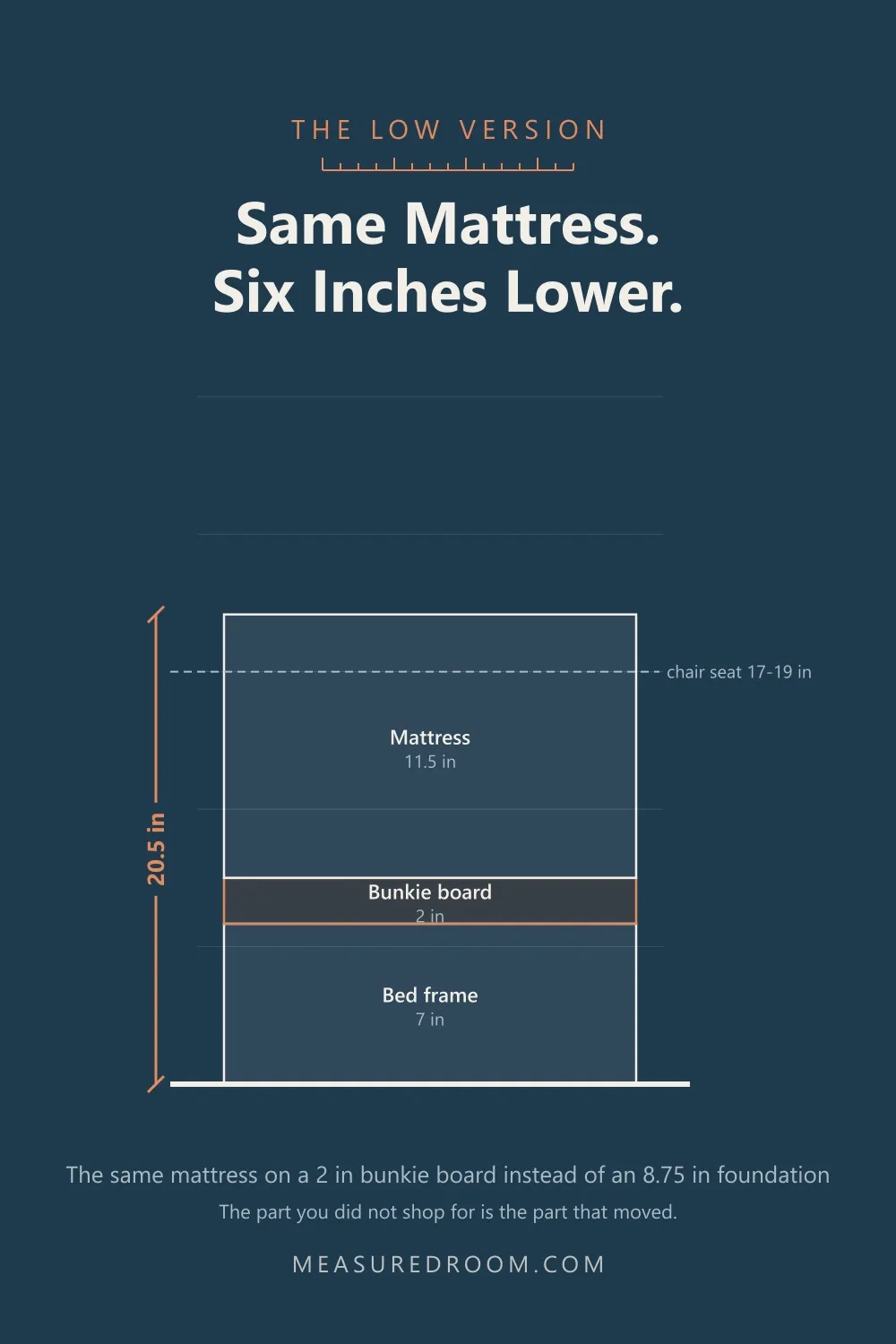
| 7 in | 2 in (bunkie) | 11.5 in | 20.5 in |
| 7 in | 4.75 in | 11.5 in | 23.25 in |
| 7 in | 2 in (bunkie) | 14.5 in | 23.5 in |
| 7 in | 8.75 in | 11.5 in | 27.25 in |
| 7 in | 4.75 in | 14.5 in | 26.25 in |
| 7 in | 8.75 in | 14.5 in | 30.25 in |
Nearly ten inches of spread — 9.75 to be exact — and the mattress only accounts for three of them. The part most people never think about — the foundation — moves the bed almost seven inches on its own.
What height should you actually aim for?
There is no regulation here, so use a reference you already own.
A dining chair seat sits at 17 to 19 inches. That is the height the furniture industry settled on for “an adult sits down and stands up from this many times a day”. A bed you sit on the edge of to put socks on is doing the same job.
The test is your feet. Sit on the edge of the mattress. If your feet are flat on the floor and your knees are at roughly a right angle, the height is right for you. If your toes dangle, it is too high. If your knees come up toward your chest, it is too low.
That test beats any number we could print, because it depends on your leg length rather than an average. But it does mean you have to test at the height you will actually own — including the foundation you plan to buy, not the display foundation in the shop.
Two adjustments worth knowing:
- Higher is easier to get out of, harder to get into. If anyone using the bed has knee or hip trouble, aim toward the chair-seat range rather than above it.
- Higher makes a small room feel smaller. A 30 inch bed is a wall you see over the top of. A 21 inch bed reads as floor.
The number that catches people out
Your fitted sheets do not care about the frame or the foundation. They care about the height of what they wrap around, which is the mattress plus anything you put on top of it.
Pocket depths come in three bands:
| Fits a mattress of | |
|---|---|
| Standard | 7–12 in |
| Deep | 13–17 in |
| Extra deep | 18–25 in |
And the rule of thumb, which Saatva states directly: a fitted sheet should be 1 to 2 inches deeper than the mattress it goes on. A sheet that exactly matches will not stay on the corners.
So the Classic at 11.5 in wants a standard pocket, and at 14.5 in it needs a deep pocket. Straightforward — until you add a topper.
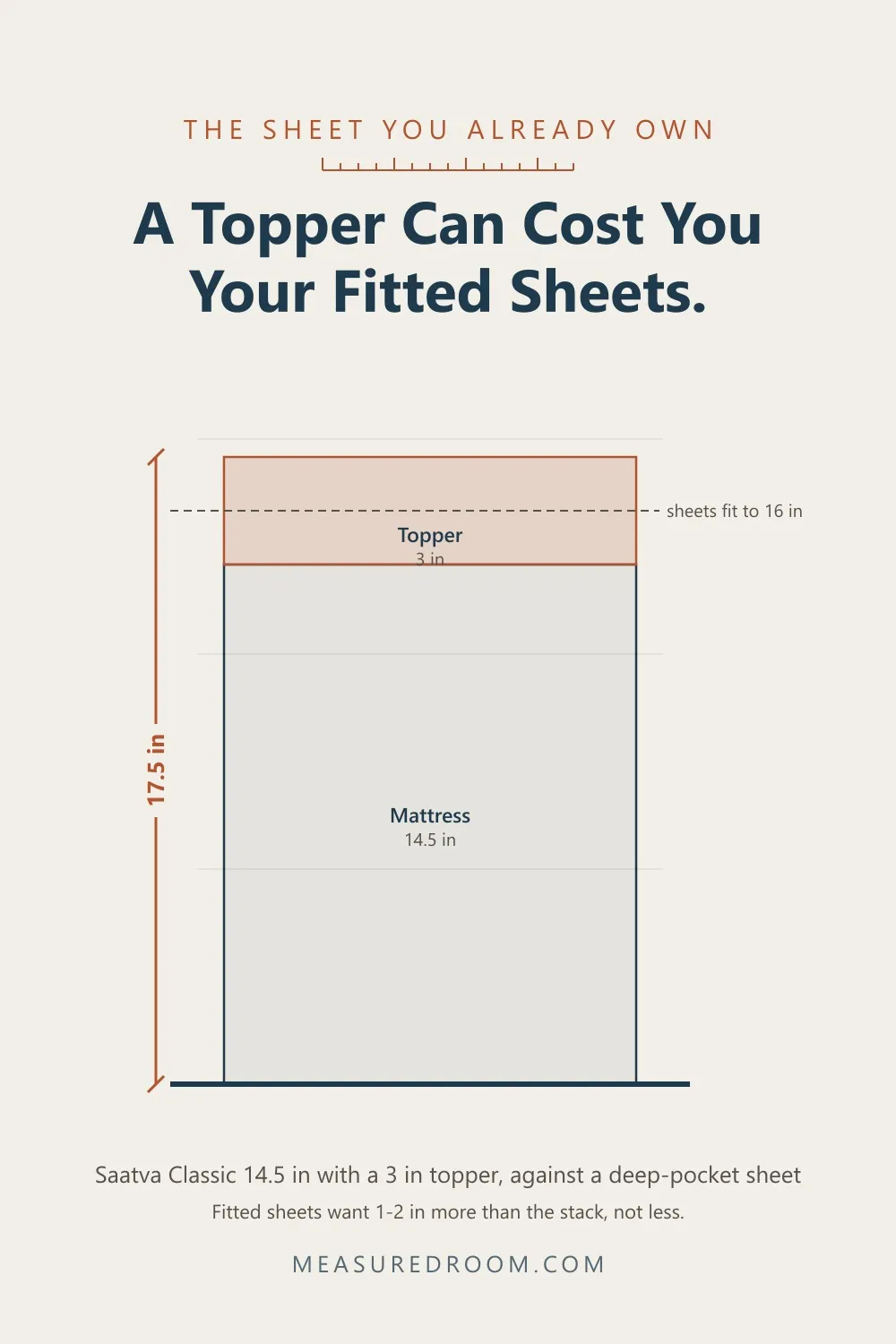
Saatva’s own organic cotton sheets specify “deep pockets for mattresses up to 16 in high.” Put a 3 inch topper on the 14.5 inch Classic and the stack is 17.5 inches. That is past the limit, and by the 1-to-2-inch rule you actually wanted a sheet rated to 19 inches.
Nothing about that is obvious at the point of purchase. The topper page talks about comfort. The sheet page talks about thread count. The only place the conflict appears is on your bed at eleven at night, with a corner that keeps pinging off.
If you plan to use a topper, add its height before you buy sheets, and buy extra deep.
Whoever you buy from, look for the pocket depth written in inches, not the words “deep pocket” — those mean anything from 14 to 22 inches depending on the brand. Sleep & Beyond, which makes organic cotton and wool bedding, is one place to check that number against your stack.
Does the size fit the room?
Height is one problem. Footprint is the other, and the answer is usually decided by what is left around the bed rather than the bed itself.
The standards: 24 inches minimum to walk beside a bed, and 36 inches in front of a dresser to open a drawer and stand there.
Here is a queen in a 10 × 11 ft bedroom — a common size, 110 square feet.
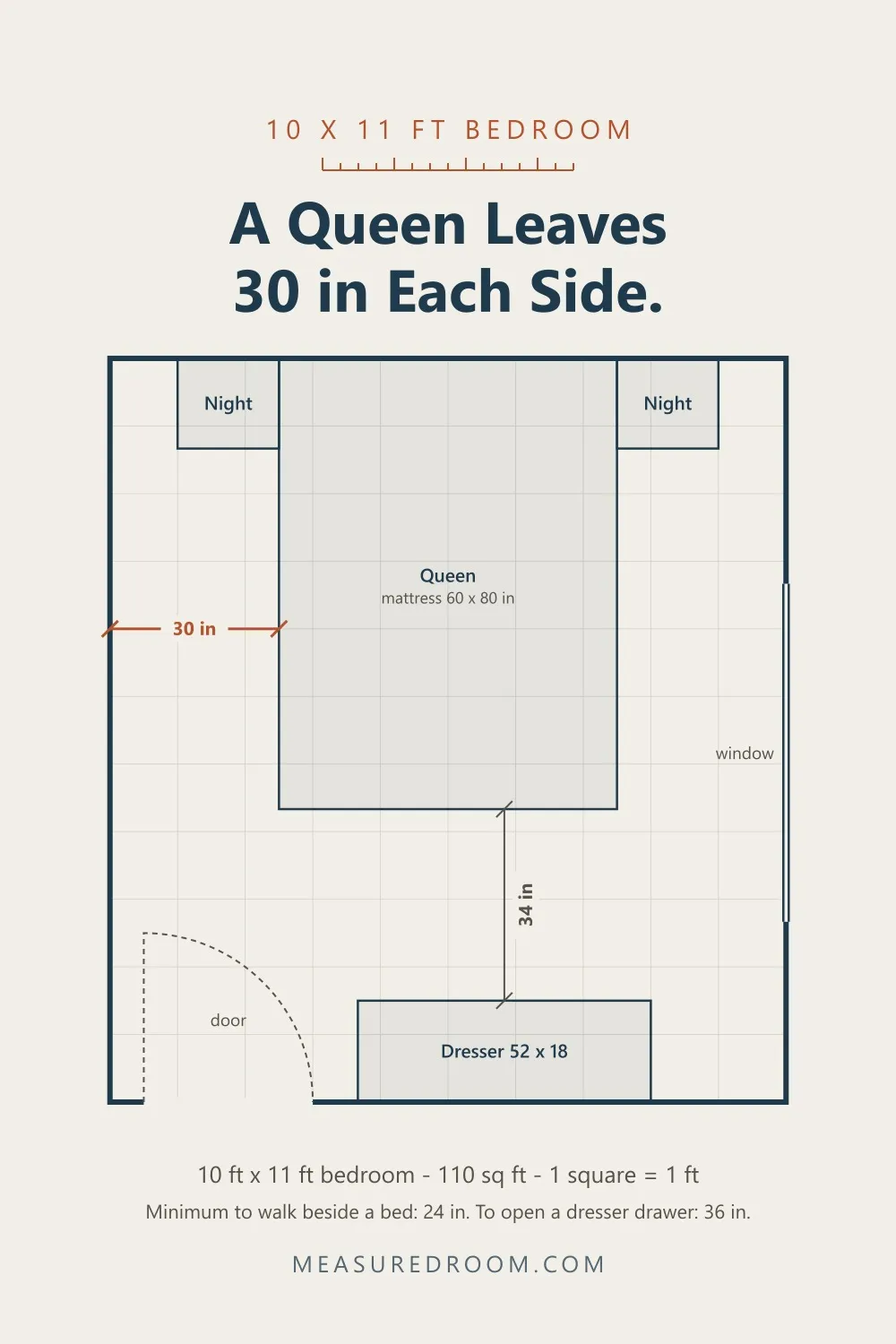
Thirty inches each side, which clears the minimum with room to spare. Past the nightstands it narrows to 12 inches, but nobody walks there — that space is doing its job holding a lamp.
Now the same room with a king.
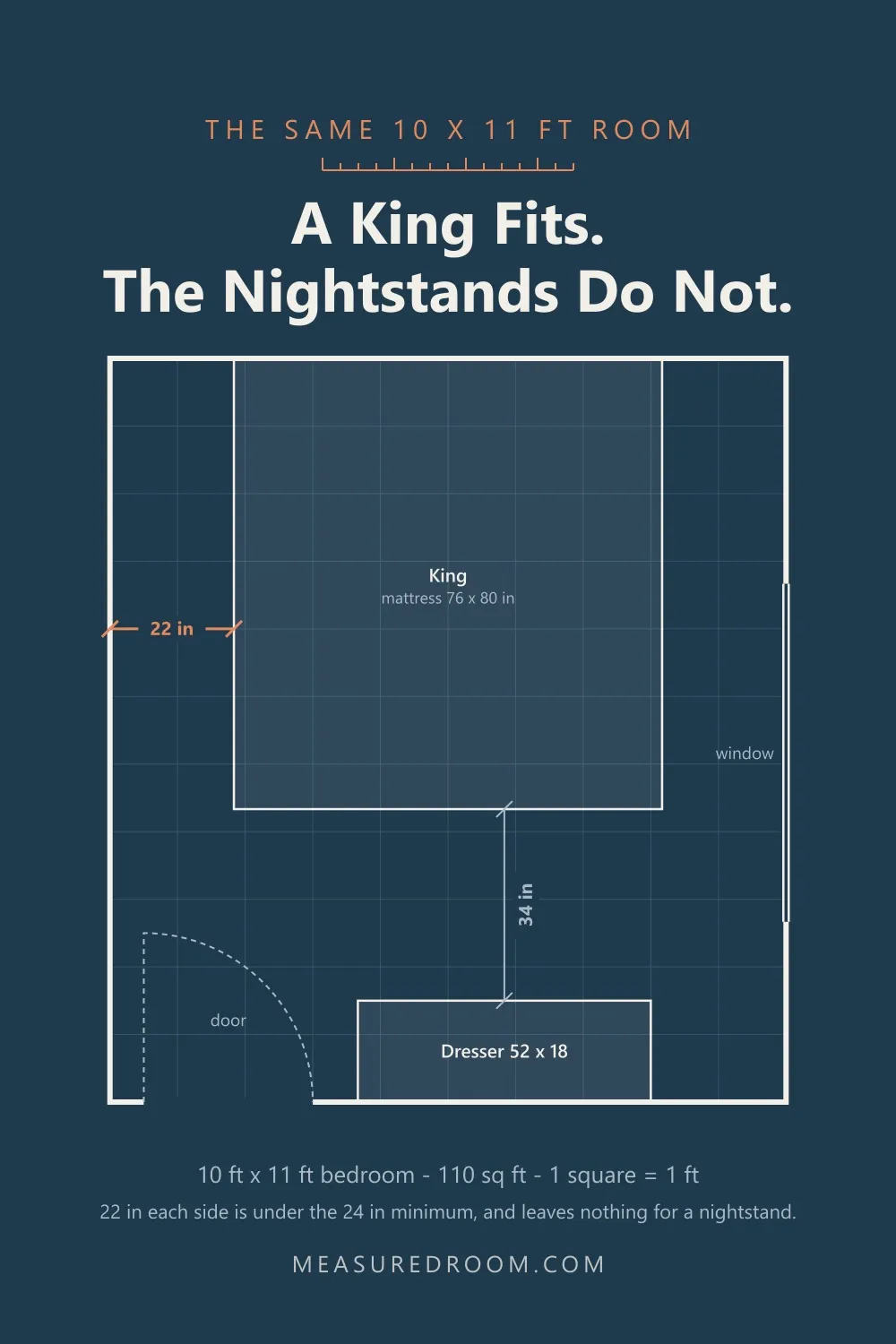
Twenty-two inches each side, and no room at all for a nightstand. The bed fits the floor. It does not fit the room. An 18 inch nightstand would leave four inches to squeeze past, which is not a gap, it is a wall.
In both plans the dresser sits 34 inches from the foot of the bed — two inches under the 36 you want to open a drawer comfortably. In a 110 square foot room, something is always slightly short. Knowing which thing is short is the whole point of drawing it.
Take these numbers to the store
Bed height and size checklist
16 items · 4 categories
Bed height and size checklist — measuredroom.com
Measure in inches with a steel tape. The three heights below are three separate purchases — get all three before you commit to any of them.
The room
- Wall the headboard will go against — its width
- Clear floor each side of where the bed will sit (want 24 in minimum)
- Distance from the foot of the bed to whatever is opposite
- Ceiling height, if a canopy or loft bed is under consideration
The stack
- Bed frame height, floor to the deck the foundation sits on
- Foundation height (they are commonly sold in two or three heights)
- Mattress height — check which profile you are ordering
- Add the three. That total is what you sit on.
The sit test
- Sit on the edge at the height you will actually own
- Feet flat on the floor?
- Knees at roughly a right angle?
- Compare against a dining chair at home (17–19 in)
The bedding
- Mattress height, plus any topper you plan to add
- Fitted sheet pocket depth — want 1 to 2 in more than that total
- Bed skirt drop, if using one: frame height plus foundation height
- Check the sheet you already own before assuming it still fits
If you take one thing away: the mattress is the part you shop for, and the foundation is the part that decides how high the bed ends up. One is a long decision about comfort. The other is a checkbox at the end of the order, chosen in four seconds, worth almost seven inches.
Spend a little of the first decision’s attention on the second one.