Will It Fit? The Measurements That Decide Whether a Sofa Works
DisclosureThis page contains affiliate links. If you buy through them, we may earn a commission at no extra cost to you.
A sofa is the one piece of furniture that can be exactly right in every way — color, price, comfort, reviews — and still be wrong, because it does not physically get into the room. Large-item returns are the most expensive kind: someone has to come back for it, and you are usually paying for that trip.
Everything below is measuring. It takes about fifteen minutes and it happens before you open a single product page.

Start with the room, not the sofa
Write down five numbers. Not “about eleven feet” — actual numbers, taken with a tape.
- The wall. The clear length of the wall the sofa will sit against, measured between whatever interrupts it: a radiator, a door casing, the edge of a window you do not want covered.
- The room depth. Wall to wall, in the direction you will walk.
- The walkway. The path people take through the room. Where is it, and how wide is it right now?
- Every opening on the delivery route. The building entrance, the elevator, the turn at the top of the stairs, the apartment door, the living room door. The narrowest one is the only one that matters, and it is rarely the one you expect.
- The turn. At each doorway, the width of the space in front of it — the hallway or landing the sofa has to pivot in.
The last two are where deliveries fail. A sofa that clears the doorway on paper still has to be swung into position in the hallway outside it.
The doorway test
Sofas do not go through doors flat. They go through tilted, standing on one arm, pivoted around the corner of the frame. The measurement that decides whether that works is diagonal depth: the distance from the highest point at the back of the sofa to the lowest point at the front, ignoring the legs.
To take it physically, stand the sofa’s back against a wall, lay a straightedge from the top of the back down to the front edge of the seat frame, and measure from that line to the back bottom corner at a right angle.
To estimate it from a listing, use the bounding box:
box diagonal = √(height² + depth²)A sofa listed at 33 in high and 34 in deep gives √(33² + 34²) ≈ 47.4 in. That is a deliberately pessimistic number — most sofas have a back that slopes, so the real diagonal comes in a few inches under the box diagonal. Treat it as the upper bound: if the box diagonal already clears your narrowest opening, you can stop worrying.
If it does not clear, you have three things to try before giving up on the sofa:
- Take the legs off. Most screw off, and they are usually worth 2–5 in of height.
- Take the door off its hinges. Typically another inch or two of clear width, and it removes the hardware you would otherwise be dragging fabric across.
- Strip the cushions. Back and seat cushions off, arm covers off. On a soft-backed sofa this is not a rounding error.
| Opening | Typical clear width | What usually clears it |
|---|---|---|
| Interior door, standard | 30–32 in | Apartment-scale sofas, most loveseats |
| Front door of a house | 36 in | Most full-depth sofas, tilted |
| Older or prewar apartment door | 26–28 in | Modular pieces, chairs, loveseats |
Measure your own rather than trusting the row. Door width is the clear opening with the door open, jamb to jamb — not the width of the door leaf.

Clearances that make a room usable
Fitting is the low bar. The room also has to work once the sofa is in it.
| Between | Leave |
|---|---|
| Sofa and coffee table | 14–18 in |
| Main path through the room | 36 in (30 in absolute minimum) |
| Secondary path between two pieces | 30 in |
These are the standard residential figures — 36 inches is roughly what two adults need to pass without turning sideways, and 14 to 18 inches is close enough to reach a mug but far enough to stand up without barking your shins.
Now do the subtraction. In a room 12 ft deep, a sofa 38 in deep against one wall leaves 106 in. Put a 20 in coffee table 16 in off the sofa and you have used 74 in — leaving 70 in for a media unit and the walkway. That is comfortable. Repeat it with a sofa 44 in deep and a 30 in media unit and the walkway is down to 34 in — under the minimum, never mind the target.
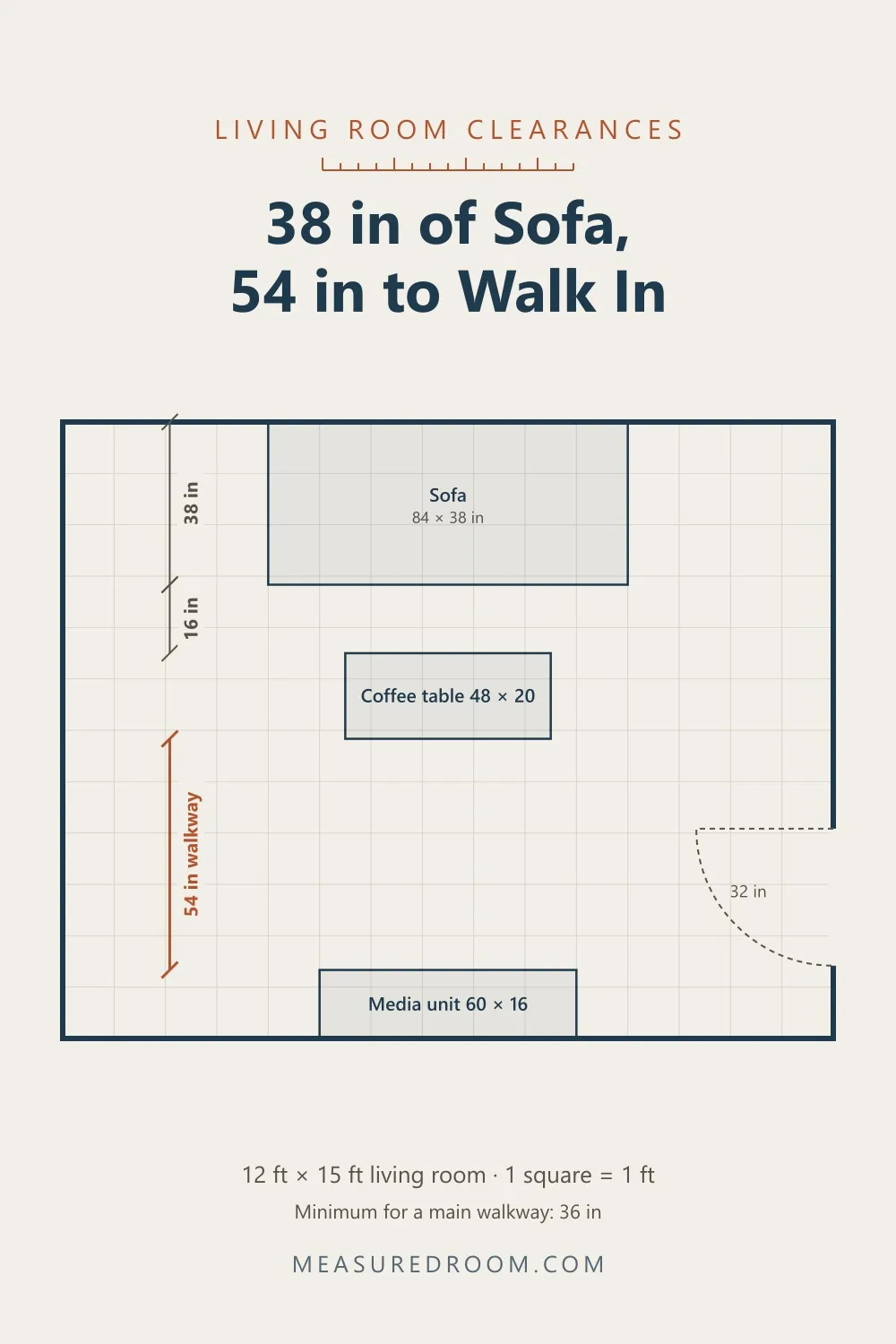
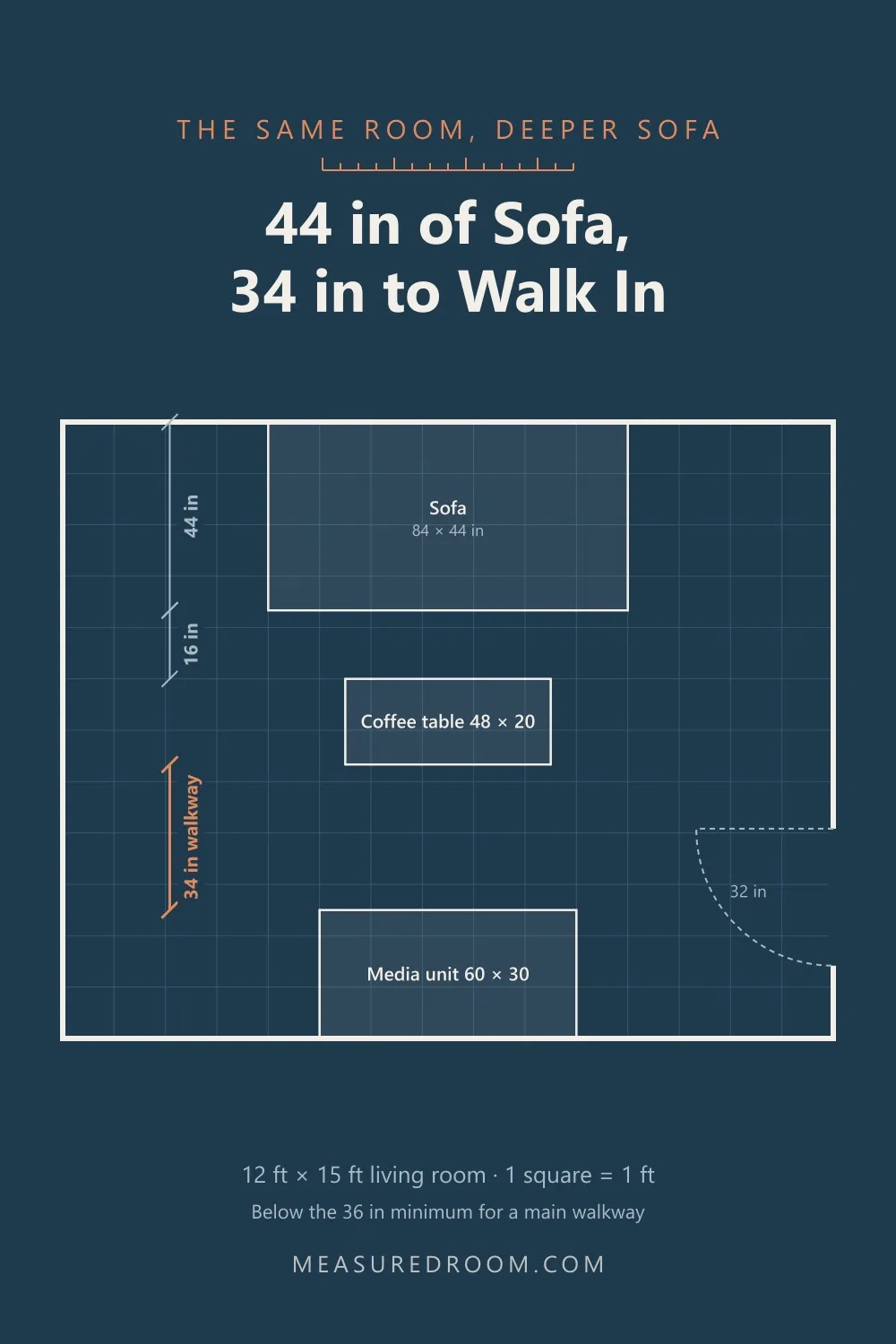
Every extra inch of sofa depth comes directly out of the walkway. That is the whole trade-off, and it is why depth deserves more attention than width.
Overall depth is not seat depth
This is the number listings bury, and it is the one you actually sit on.
- Overall depth is the full front-to-back footprint, including the back cushion and frame. It is what you subtract from the room.
- Seat depth is the usable surface, from the front edge to the face of the back cushion. It is what decides whether you sit or sprawl.
On a standard-back sofa the gap between them runs about 8 to 12 inches. Seat depths cluster in three bands:
| Seat depth | Sits like |
|---|---|
| 20–22 in | Upright. Feet flat on the floor, easy to get out of |
| 22–24 in | The default. Works for most heights |
| 24 in and over | Lounge depth. Comfortable reclined, awkward upright without cushions |
If a listing gives you a single depth figure, it is almost always the overall depth. Deep-seat sofas are usually advertised as such, because it is a selling point — but confirm before you assume, especially if anyone in the house is short or has trouble standing up from low seating.
Scale, in two rules
Once it fits and the room still works, there is the question of whether it looks right.
- The sofa should be roughly two-thirds the length of its wall. Much less and it floats; much more and the wall looks overstuffed.
- The coffee table should be roughly two-thirds the length of the sofa.
These are not laws, but they are why a room can be perfectly measured and still look off.
What to check on each brand’s spec page
Different brands publish different numbers, and the gaps tell you what to ask about.
- Article lists overall dimensions along with seat depth and leg height in the spec tab. Leg height matters more than it sounds: it decides whether the sofa reads as heavy in a small room, and whether a rug pile clears it.
- Burrow ships modular pieces in boxes and assembles without tools, so the doorway test applies to the cartons rather than to a finished sofa. If your narrowest opening is a problem, this is the category that solves it.
- Lovesac sells Sactionals as separate seats and sides, which means the same arithmetic — measure the units, not the assembled sectional — and the arrangement can be changed later if you move.
- Coddle publishes seat height alongside overall and seat depth, and on its sleeper models it publishes the opened bed size as well. That last number is the one to find before anything else if the sofa has to double as a guest bed, because it is floor you lose in front of the sofa rather than against the wall. Its pieces arrive fully assembled, so the doorway test applies to the finished sofa and not to cartons.
- Saatva is the bedroom equivalent of the same problem. The Classic comes in 11.5 in and 14.5 in profiles, and the profile you pick has to work with your bed frame height and your fitted sheet’s pocket depth.
Prices, dimensions, and delivery terms change; the brand’s own spec page on the day you order is the authority.
The checklist
Print this, walk the apartment with it, and fill it in before you open a single product page.
Sofa Measuring Checklist
25 items · 4 categories
Sofa Measuring Checklist — measuredroom.com
Measure in inches, to the nearest half inch. Where a route has two openings, record the narrower one.
The room
- Clear wall length for the sofa
- Room depth, wall to wall
- Current walkway width
- Distance from sofa wall to coffee table position
- Window sill height, if the sofa sits under one
- Radiator, vent, or outlet positions along the wall
The delivery route
- Building entrance width
- Elevator car depth and door width
- Stair width and landing turn
- Apartment or house door, clear opening
- Living room door, clear opening
- Hallway width in front of each door
- Ceiling height at the tightest turn
From the listing
- Overall width
- Overall depth
- Overall height
- Seat depth
- Seat height
- Leg height, and whether legs remove
- Box dimensions, if it ships flat
Before you order
- Box diagonal √(height² + depth²) vs narrowest opening
- Walkway left after the sofa and table are in
- Return policy: window, pickup fee, restocking fee
- Delivery type: curbside, threshold, or in-room
- Lead time and whether it ships in one delivery
The fifteen-minute version
If you do nothing else: measure the narrowest opening on the route, compute √(height² + depth²) from the listing, and subtract the sofa’s depth from your room depth to see what walkway you are left with. Those three numbers catch almost every expensive mistake.