The Delivery Route Checklist: Measure Before They Arrive

DisclosureThis page contains affiliate links. If you buy through them, we may earn a commission at no extra cost to you.
A sofa that fits your living room can still be standing in your driveway at four in the afternoon, wrapped, paid for, and going back on the truck. The room was never the problem. The problem was somewhere between the curb and the room — a landing, a stair turn, a radiator in the hall — and nobody measured it, because it is not the part anyone thinks to measure.
This is the route, station by station. It takes about twenty minutes with a tape and a phone, and it is the single highest-value thing you can do before ordering anything large.
Walk it backwards
Start in the room where the furniture is going to live, and walk out toward the street. Measure in that direction.
It sounds like a detail, and it is not. Walking outward, the first hard number you hit is usually the one that ends the conversation — the bedroom door, the turn at the top of the stairs. Walking inward from the truck, you spend the first ten minutes measuring a building entrance that was never going to be the constraint, and you arrive at the real choke point already tired of the exercise.
Backwards also matches how the failure actually happens. The crew gets the piece to the apartment door, and then discovers there is nowhere to pivot. Everything before that point was fine.
The eight stations
Write down a number for each. Not “wide enough” — a number, in inches, to the nearest half inch.
- Where the truck stops. How far is it from the nearest legal parking to your door, and is there a step, a slope, gravel, or a gate? Some carriers charge for a long carry; some simply will not do one.
- The building entrance. Clear width with the door open and held — jamb to jamb, not the width of the door leaf. Note whether it is a double door with a removable centre post, which is often worth 12 in or more that nobody offers you unless you ask.
- The lobby or entryway. Not its width — the space to pivot in. Measure the distance from the entrance to the wall or stair opposite it.
- The stairs. Clear width between handrails, the headroom over the flight, and the depth of every landing where the stairs change direction. A landing that is shorter than the piece is a hard stop.
- The elevator. Car width, car depth, door clear width, and interior height. Then ask the building whether the ceiling panel or the escape hatch opens — some cars will take a piece stood on end that will not go in flat, and the building will not mention it on their own.
- The apartment or house door. Clear opening, and whether the door removes from its hinges.
- The turn in front of that door. The width of the corridor or landing the piece has to swing in. This is the one that fails.
- The room door. Clear opening, plus anything mounted beside it — a thermostat, a radiator, a light switch plate on a return wall — that narrows the real opening below the framed one.
| Opening | Typical clear width |
|---|---|
| Interior door, standard | 30–32 in |
| Front door of a house | 36 in |
| Older or prewar apartment door | 26–28 in |
| Main corridor in a residential building | 36–48 in |
Measure your own rather than trusting the row. The table is here so you know when a number looks wrong, not so you can skip the tape.
The corner is what fails
A doorway is a one-dimensional problem: the piece is narrower than the opening or it is not. A corner is a two-dimensional one, and it has a real answer.
Two corridors meeting at a right angle, one a inches wide and the other b inches wide, will pass a rigid panel up to this length:
longest panel = (a^(2/3) + b^(2/3))^(3/2)That is the geometric ceiling for something thin — a flat-packed carton, a headboard, a table top. A carton with real thickness turns less, because the thickness has to live somewhere while the panel is diagonal across the corner. Treat the number as the upper bound: if your longest carton is already longer than this, stop. No technique gets it around.
| Hall A | Hall B | Longest panel that turns |
|---|---|---|
| 28 in | 28 in | 79 in |
| 30 in | 30 in | 84 in |
| 30 in | 36 in | 93 in |
| 36 in | 36 in | 101 in |
| 36 in | 42 in | 110 in |
| 42 in | 42 in | 118 in |
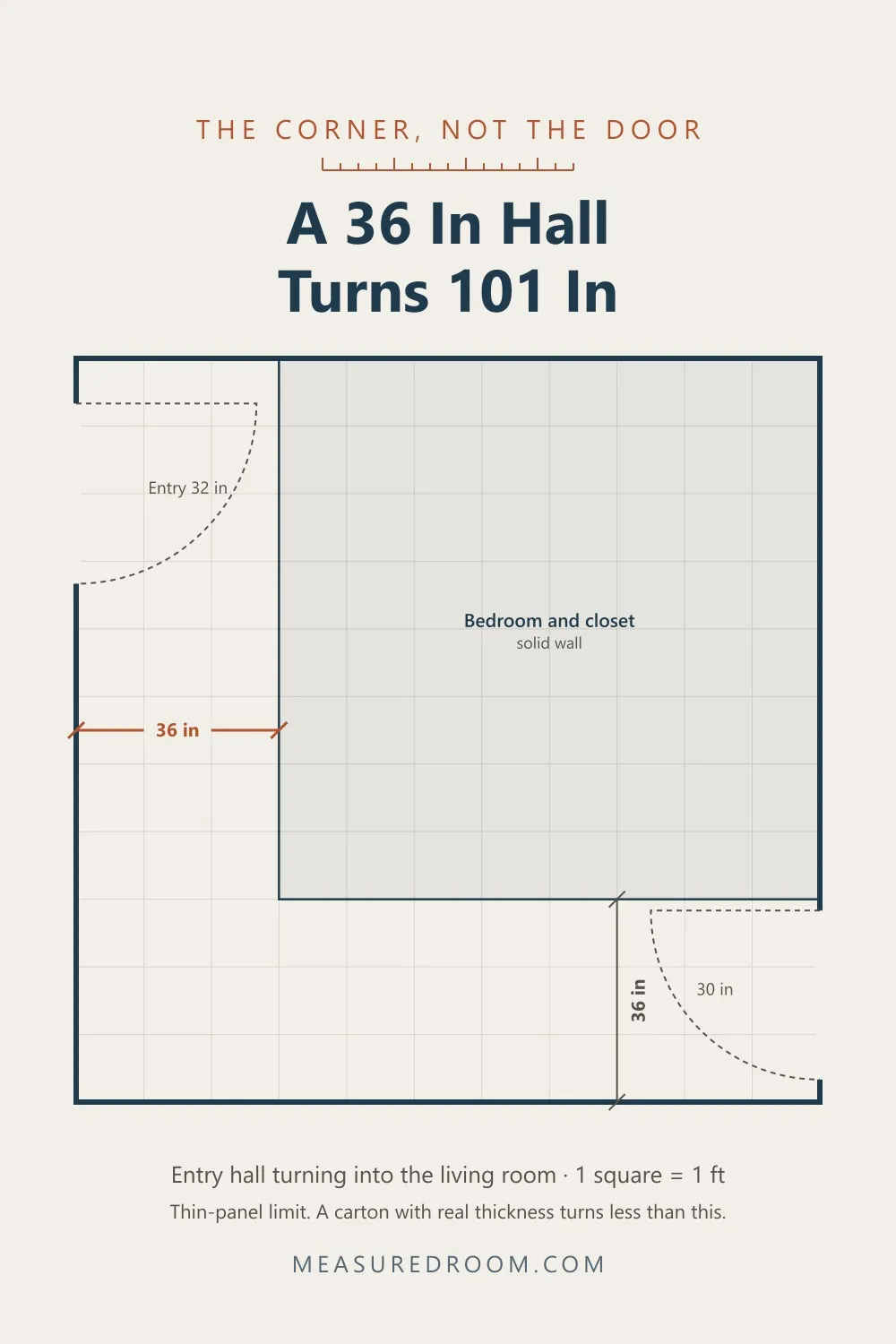
The two halls do not contribute equally, and neither does losing a few inches. Narrow one 36 in hall to 30 in — the width of a hallway with a shoe rack in it — and the corner goes from 101 in to 93 in. Six inches of hall costs nine inches of carton.
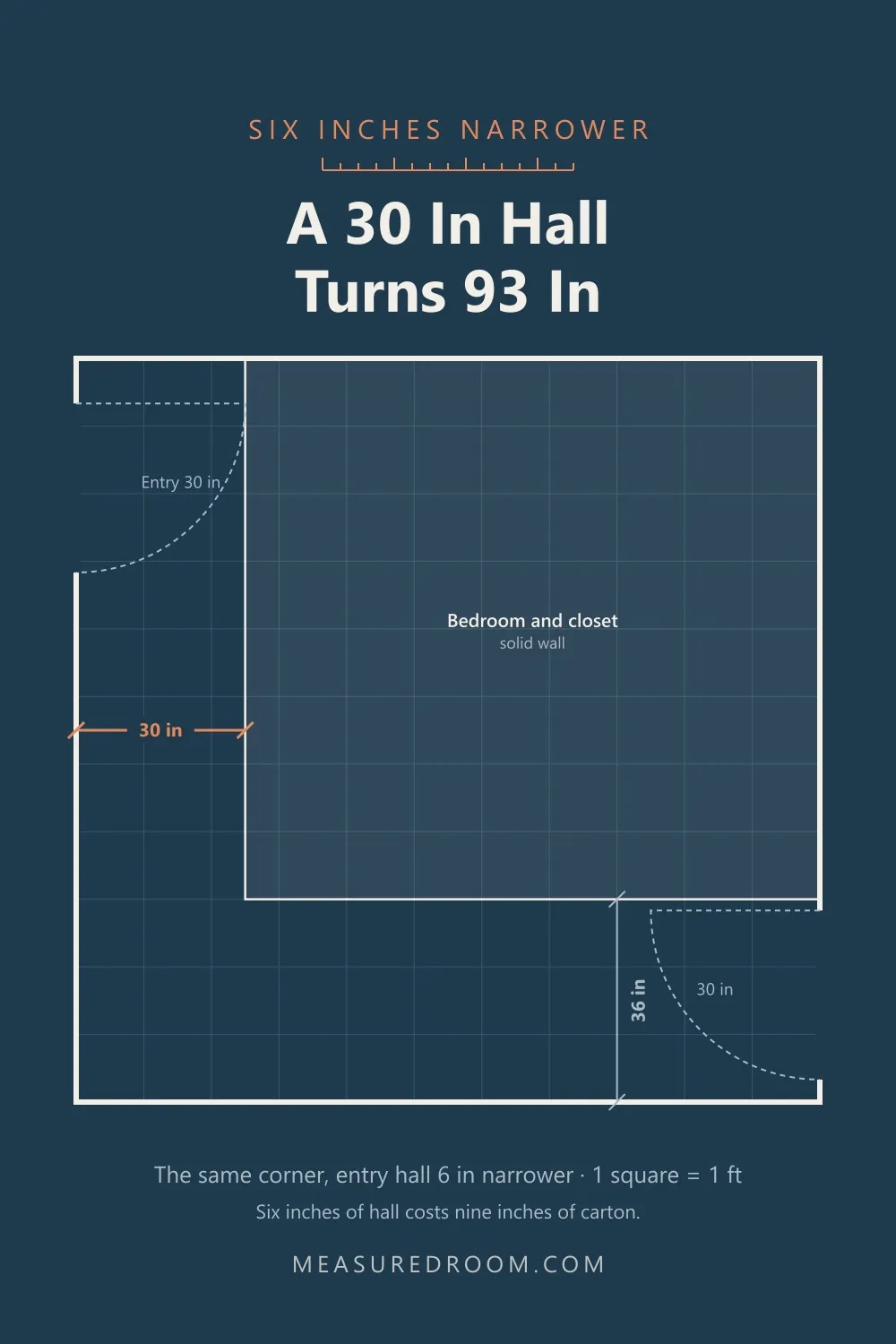
Put a real number against it. In the sectional comparison the Article Sven sofa ships in one box 91 in long. Through a 36 in by 36 in corner that is comfortable. Through a 30 in by 36 in corner it is two inches under a ceiling that assumes zero thickness — which is to say it does not go. The same brand’s sectional ships in two boxes, the longer 71 in, and turns that corner without anyone thinking about it. The larger sofa is the easier delivery.
This is also why crews ask about ceiling height at the turn, which otherwise sounds like an odd question. The formula assumes the piece stays flat in plan. If the ceiling is high enough to stand the piece on end and walk it around vertically, the corner stops binding and the headroom takes over as the constraint. That is the difference between a stairwell that works and one that does not.
What buys inches, and what each is worth
When a station comes up short, in the order you should try them:
- Take the legs off. Most screw off. Usually worth 2–5 in of height, and it is the change that most often turns a no into a yes at a doorway.
- Strip the cushions. Back cushions, seat cushions, arm covers. On a soft-backed piece this is not a rounding error.
- Take the door off its hinges. Typically another inch or two of clear width, and it removes the hardware you would otherwise be dragging upholstery across. Lift-off hinges make this a two-minute job; painted-in hinge pins do not.
- Change which way it goes in. A piece that will not turn a corner flat sometimes goes in on end, or through a different door, or in through a ground-floor window opening. Measure the alternative before you assume it is worse.
- Change what you are buying. If the narrowest station cannot be fixed, the answer is a piece that arrives in parts small enough to clear it. That is a product decision, not a delivery one.
Two things to settle before delivery day rather than during it: whether the crew is permitted to remove a door, and whether they are permitted to hoist. Delivery contracts commonly exclude both, and a crew that is not allowed to touch your hinges will stand there while you find a screwdriver. Read the retailer’s delivery terms and, if you need a door off, take it off yourself the night before.
The three tiers, and which one you actually bought
The names vary by retailer, but the tiers do not. The one on your order confirmation is the one that shows up.
| Tier | Where it ends | Who carries it |
|---|---|---|
| Curbside | The kerb, or the ground-floor entrance | You |
| Threshold | Just inside the first door | You, past that point |
| Room of choice | The room you designate, still boxed | The crew |
| White glove / full service | Placed, assembled, packaging removed | The crew |
Curbside is the one that surprises people, because on a small item it is invisible and on a sofa it means two adults and a dolly at a time the carrier chooses. Threshold on a third-floor walk-up means the piece ends its journey in the building lobby.
Check three things in the delivery terms before you order: which tier is included at that price, whether stairs cost extra and from which floor, and what happens if the piece will not go in. That last one is the expensive one — a refused delivery is frequently charged as a return, with the outbound shipping kept and a restocking fee on top.
Delivery day
- Photograph the route before anyone arrives. The hall, the stairwell, the door casings, the floor. Dated photos taken before the carry are what settle a damage claim; photos taken after it are an argument.
- Clear the route the night before. Rugs rolled up, pictures off the hallway walls, the hall light on, the coat rack in another room. Crews work fast and the walls that get scuffed are the ones nobody thought about.
- Have the tape in your hand. If the crew says it will not fit, you want to be able to check which station and by how much, while they are still there.
- Do not sign clean if it is not clean. Note visible damage on the delivery receipt before signing, and open the cartons while the crew is present if the tier allows it. Once you have signed off, the burden of proving it arrived damaged moves to you.
Ordering around a route you cannot change
Some routes cannot be fixed. A prewar hallway is what it is. In that case the route is a specification, and you shop against it.
- Burrow is built for exactly this case: the pieces ship as separate cartons and assemble without tools, so what has to clear your corner is a box rather than a finished sofa. Check the published carton dimensions on the spec page — that is the number to run through the corner formula, not the assembled sofa’s.
- Lovesac sells Sactionals as individual seats and sides, so the same logic applies: measure the units, not the assembled sectional, and the arrangement can change later if you move.
- Article publishes overall dimensions along with seat depth and leg height. Leg height is the one to note here, because removable legs are what you fall back on at a tight doorway.
- Saatva is the bedroom version of the problem. A mattress that arrives compressed in a box turns any corner; one that arrives at full height does not, and a bed frame is a stack of long flat panels that the corner formula applies to directly.
Delivery tiers, carton dimensions, and stair fees change; the retailer’s own delivery page on the day you order is the authority.
The checklist
Print this, walk the route from the room outward, and fill in a number at every station.
Delivery Route Checklist
30 items · 5 categories
Delivery Route Checklist — measuredroom.com
Measure in inches, to the nearest half inch. Record the clear opening — jamb to jamb with the door open — not the width of the door leaf.
The room
- Room door, clear opening
- Anything mounted beside the door that narrows it
- Ceiling height at the door
- Clear floor to set the piece down while it is unwrapped
Inside the building
- Hallway width outside the room door
- Apartment or house door, clear opening
- Corridor width in front of that door
- Corner: both hall widths, and the formula result
- Stair width between handrails
- Headroom over the stair flight
- Depth of every landing where the stairs turn
- Elevator car width, depth, and door clear width
- Elevator interior height, and whether the ceiling opens
Getting to the building
- Building entrance, clear opening
- Whether a double door has a removable centre post
- Space to pivot inside the entrance
- Distance from legal parking to the door
- Steps, slope, or gravel on that stretch
- Whether a lift or loading bay must be booked
From the order
- Longest carton dimension
- Carton height and depth
- Number of cartons, and whether they ship together
- Delivery tier: curbside, threshold, room of choice, full service
- Stair fee, and from which floor it starts
- What is charged if the piece will not go in
- Whether the crew may remove a door or hoist
Delivery day
- Photos of hall, stairs, casings, and floor — before the carry
- Route cleared: rugs up, walls bare, lights on
- Tape measure to hand
- Damage noted on the receipt before signing
The twenty-minute version
If you do nothing else: measure the narrowest opening on the route, measure both halls at the tightest corner and run (a^(2/3) + b^(2/3))^(3/2), and read which delivery tier is on your order. Those three checks catch nearly every delivery that ends with the piece going back on the truck.
Related: the sofa measurements that decide whether it fits the room, once you know it can get there.