Sectional vs Sofa: Which One Your Room Can Take
DisclosureThis page contains affiliate links. If you buy through them, we may earn a commission at no extra cost to you.
Put a three-seat sofa and a chaise sectional side by side in a showroom and the honest difference is small: a couple of extra seats, a place to put your legs up. Put them in the same living room and the difference is 29 in of floor.
That number is not an opinion. It is the gap between two published depths at one brand, on the same sofa line, and it decides the room before anything about comfort or upholstery gets a vote.
Same seats, different question
A sofa is a straight line. It wants one wall, and everything else in the room is still yours to arrange — the walkway can run in front of it, beside it, or both.
A sectional is a corner. It wants either two walls or one wall plus a run out into the middle of the floor, and the moment the chaise leaves the wall, the room stops being rearrangeable in that direction.
So the useful question is not which one is better. It is which one your room can take. That is answerable, from numbers both brands already publish.
The measurement that actually decides it
For a straight sofa you check two numbers: overall width, which is the wall run it needs, and overall depth, which is what comes out of your floor. The difference between overall depth and seat depth is in the shallow-sofa shortlist.
A sectional has a third number, and it is the one that catches people out. The chaise is measured along a different axis than the body. Take the Article Sven line, which sells a sofa and a chaise sectional in the same design, so the comparison is as close to controlled as retail gets. Published dimensions, read on 28 August 2026:
| Sven 88“ Sofa | Sven 100“ Right Chaise Sectional | |
|---|---|---|
| Overall width | 88 in | 100 in |
| Overall depth | 38 in | 67 in |
| Overall height | 34 in | 34 in |
| Seat height | 19 in | 19.5 in |
| Seat depth | 24 in | 24 in (love seat), 52 in (chaise) |
| Arm height | 27 in | 27.5 in |
| Weight | 126 lb | 174 lb |
The sectional is 12 inches wider and 29 inches deeper. Almost everybody shopping expects the first number and almost nobody plans for the second. You are not buying a longer sofa. You are buying a sofa that reaches most of the way across a twelve-foot room.
Where the body depth hides
Here is the annoying part: Article publishes one overall depth for the sectional, not two. The 67 inches is the chaise. The depth of the body — the part you actually put against the wall — is not on the spec tab.
You can recover it from the numbers that are there. Overall depth 67 in minus chaise seat depth 52 in leaves 15 in of back cushion and frame behind the seat. Apply that same 15 inches to the love seat’s 24 in seat and the body lands at 39 in — within an inch of the Sven sofa’s published 38 in.
Which is the sane answer: the body of the sectional is the sofa. The chaise is the extra.
Do the subtraction yourself before you assume it. At Article’s Abisko sectional the same trick does not work, because the page publishes a single seat depth of 25 in without splitting love seat from chaise. Its overall dimensions are 94.5 in wide by 63.5 in deep. That is all you get, and there is nothing dishonest about it — but it means the only depth you can plan against is the deep one.
What the L-shape costs that a straight line doesn’t
Both shapes take floor. They take it differently, and the difference is not about area.
A straight sofa spends its footprint evenly along one wall. Whatever is left is a single open region, and you can put the walkway wherever you like in it.
A chaise sectional spends the same total floor concentrated in one corner that projects into the room. The room does not get uniformly tighter. One specific path gets much tighter, and it is usually the path between the seating and the television.
That is the whole trade, and it is why “we have plenty of space” is not a good enough answer. Plenty of space in the wrong place is still a 25-inch gap.
Same room, two footprints
Same room as the doorway guide and the $3,000 living room: 12 ft deep by 15 ft wide. Same coffee table, same media unit, same 16 in gap from seat front to coffee table in both plans. The only thing that changes is the shape of the seating.
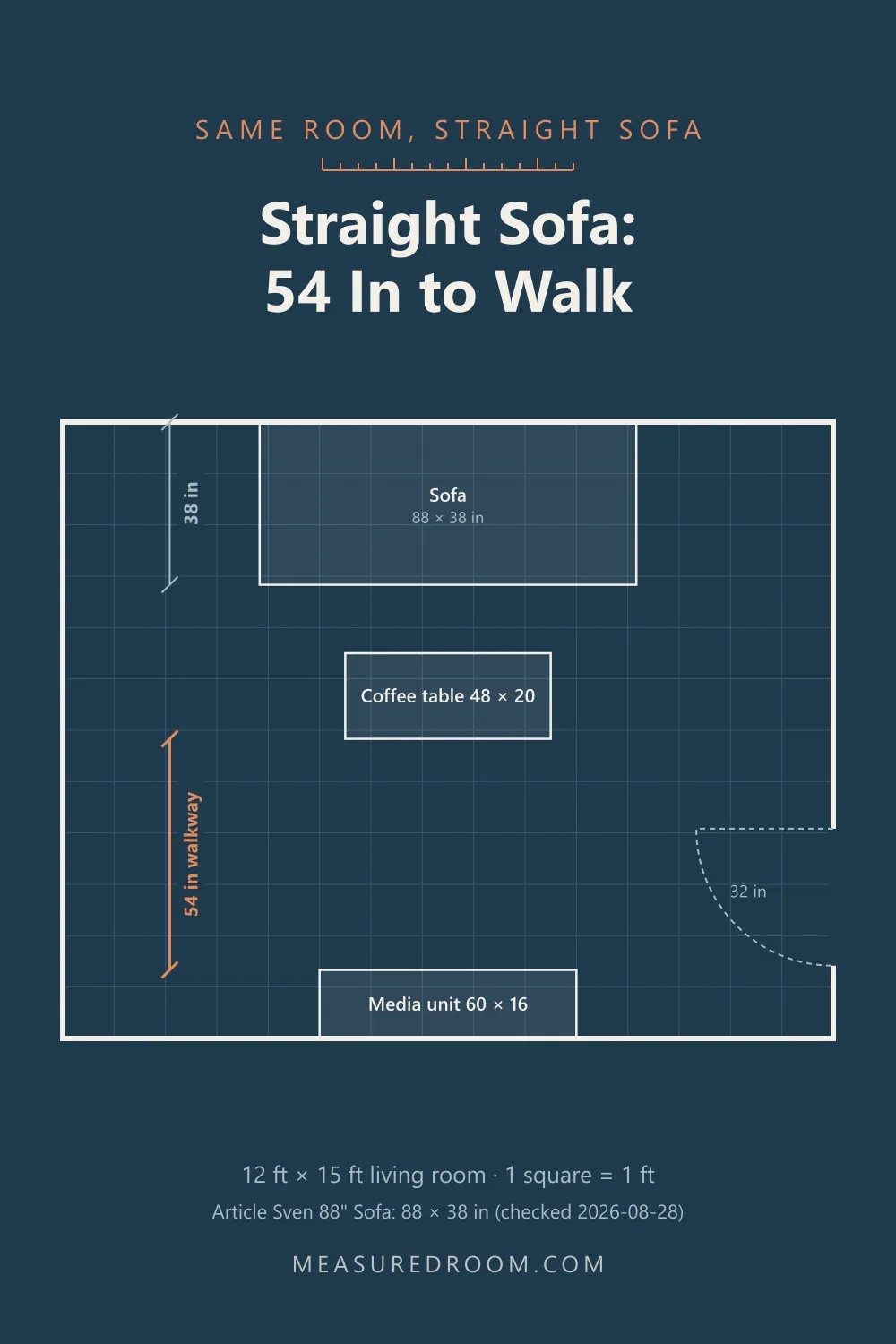
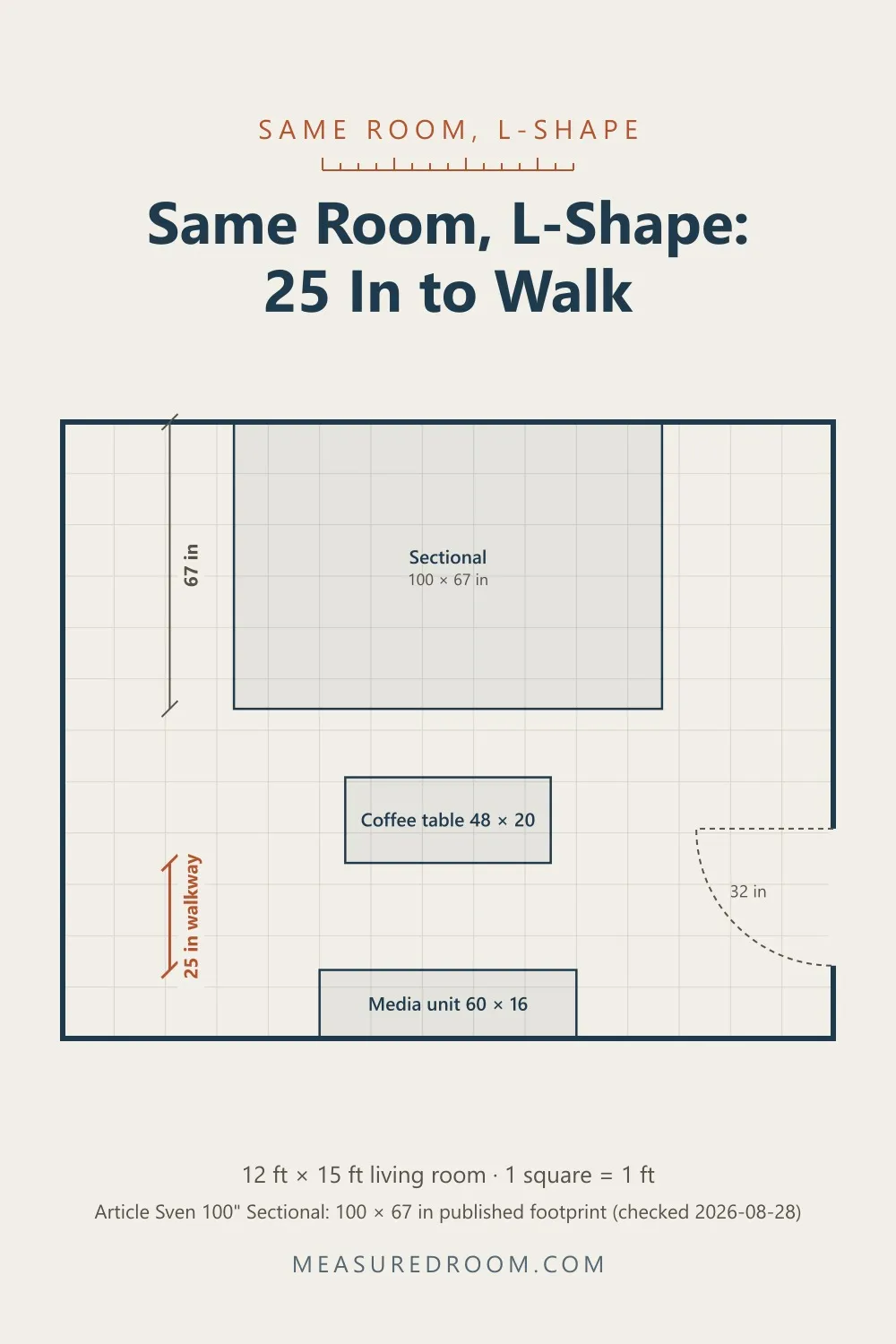
The sectional is drawn as the published footprint — a 100 × 67 in rectangle. Article does not publish where the open corner of the L falls, so that corner is not in the plan. If you are shopping a sectional and the brand will tell you the body depth, use it. If not, the rectangle is what you have to clear.
The plans are drawn to scale and the clearances are measured off the drawing, not estimated:
| Straight sofa | Chaise sectional | |
|---|---|---|
| Seating footprint | 88 × 38 in | 100 × 67 in |
| Floor occupied (all furniture) | 36.6 sq ft | 59.9 sq ft |
| Floor left open | 143.4 sq ft | 120.1 sq ft |
| Walkway, coffee table to media unit | 54 in | 25 in |
| Passage beside the seating | 46 in | 40 in |
The standard minimum for a main path through a room is 36 inches. The straight sofa clears it with 18 inches to spare. The sectional misses it by 11.
Note where the loss lands. The passage beside the seating barely moves — 46 inches to 40 — because the sectional is only 12 inches wider. The front-to-back walk collapses, because that is where the extra 29 inches went. Twenty-three square feet of floor disappeared, and essentially all of it came out of one path.
None of this says the sectional does not fit. It says that in this room, with a media unit on the far wall, it fits only if you give up the walk-through. Move the coffee table, or lose it, and the arithmetic changes. That is a real option. It is just a decision, and it should be made before the delivery, not after.
When the sectional wins anyway
Three room shapes where the L is the right answer and the straight sofa is the compromise:
- The television is in a corner, or the room’s long view is diagonal. A straight sofa facing a corner leaves everyone turned slightly wrong. The L follows the corner and the seating faces where the room already points.
- The room has more than one path through it. If the chaise blocks one route and two others survive, the 25-inch number stops mattering — nobody has to use that gap. In the plan above there is only one way across, which is exactly why it hurts.
- You need the seat count and the wall run is short. If your longest usable wall is 100 inches, a straight sofa on that wall caps out at four seats. Turning the corner is the only way to add a fifth without a second piece of furniture.
Notice what is not on that list: liking the look of a sectional. That is a fine reason to buy one. It is not a reason to expect it to fit.
What modular buys you that a fixed sectional doesn’t
A fixed chaise sectional commits you at checkout. Right-facing or left-facing, one depth, one length, forever — and if you move, the room you move into has to accept the shape you already own.
Modular systems price that flexibility in. Lovesac Sactionals are the clearest example, because every piece has a published dimension and nothing is glued to anything (read 28 August 2026):
| Piece | Published dimensions | Weight |
|---|---|---|
| Seat, standard orientation | 35 in W × 29 in D × 18 in H | 53 lb |
| Seat, deep orientation | 29 in W × 35 in D × 18 in H | — |
| Regular Side | 35 in L × 6 in W × 28.5 in H | 36 lb |
| Deep Side | 29 in L × 6 in W × 28.5 in H | 34 lb |
| Wedge Seat | 35 in at the back, 12 in at the front, about 26.75 in deep, 18 in H | 47 lb |
| Roll Arm Side | 35 in L × 6 in W × 26 in H, with a 9 in roll-out arm | 36 lb |
Read the first two rows again. It is the same seat. A standard layout puts the 35-inch edge to the front and gives you 29 inches of depth; a deep layout turns the same block ninety degrees for 35 inches of depth and 29 inches of width. Sides come in both lengths so either orientation closes up. Depth becomes a decision you make on the floor of your own living room, and unmake later.
That is the genuine advantage, and it is worth being precise about what it is not. Rearranging does not shrink the thing. Four seats occupy four seats’ worth of floor in any arrangement. You can turn an L into a straight run to free up a walkway, or trade width for depth, but if the new room is smaller you will be selling seats, not folding them away. Fewer units, fewer places to sit.
One practical note for anyone planning on paper: Lovesac publishes piece dimensions, not configuration dimensions. A three-seat standard run is 3 × 35 = 105 in of seat, plus 6 inches for each arm side, so 117 in overall — 29 inches deep at the seats, 35 with the back sides on. You have to add it up yourself, and it is worth doing before you order rather than after.
Before you order
- Settle the chaise orientation from the room, not from the picture. Sit where you will sit and face the television. The chaise goes on the side with less traffic and no doorway. Get this backwards and the chaise lands across the entrance — and orientation is usually not a returnable mistake, it is a different product.
- Measure the one path you actually walk, front to back, not just the leftover square footage. Twenty-three square feet vanishing sounds survivable. Fifty-four inches becoming twenty-five does not.
- Check whether the return is per piece or per set. On a two-box sectional this is the difference between sending back a chaise and sending back a whole sofa, and it varies by brand. Ask before, not after.
- Look at the box dimensions, and be ready to be surprised. The Sven sofa ships in one box 91 in long. The Sven sectional ships in two, the longer of them 71 in. The bigger piece of furniture has the smaller delivery problem — twenty inches less to swing through your tightest turn. Run both against the doorway method rather than assuming the sectional is the harder one.
If you only take one thing away: a sectional does not cost you width, it costs you depth. Twelve inches along the wall, twenty-nine into the room. Measure the second number against the walk you make every day, and the choice usually makes itself.
Dimensions above are the manufacturers’ own, read on 28 August 2026. They change between production runs — verify on the product page before you order.