Runner Rug Sizes, Measured: How Long and Wide for a Hallway or Kitchen
DisclosureThis page contains affiliate links. If you buy through them, we may earn a commission at no extra cost to you.
A runner rug is never as wide as the hallway, and never as long. What decides its size is the strip of bare floor it leaves — at each side, and at each end. Get those two strips right and the runner looks laid on purpose. Get them wrong and it looks like a bath mat that wandered, or carpet that stopped short.
Both strips are measurements. So here they are, worked through real hallway and kitchen dimensions, every runner drawn to scale.
The two numbers
At each side: 3 to 6 in of bare floor. Sisal Rugs Direct’s hallway guide puts the floor at 3 in and suggests 4 to 5 in as the place to start. Below 3, the edge of the runner rides up the baseboard and your shoes catch it. Above 6, the hallway reads as two strips of floor with a rug between them.
At each end: 4 to 8 in. The same guide says the runner should be at least a foot shorter than the hallway, so it can be centred — 6 in at each end, which is the middle of our range. Closer than 4 and the runner runs into the door threshold. Further than 8 and it stops looking like it belongs to that hallway.
Those are the targets for everything below. They are guidelines, not a manufacturer’s measurement, the same way 36 in is a guideline for a walkway.
The width: a 42 in hallway
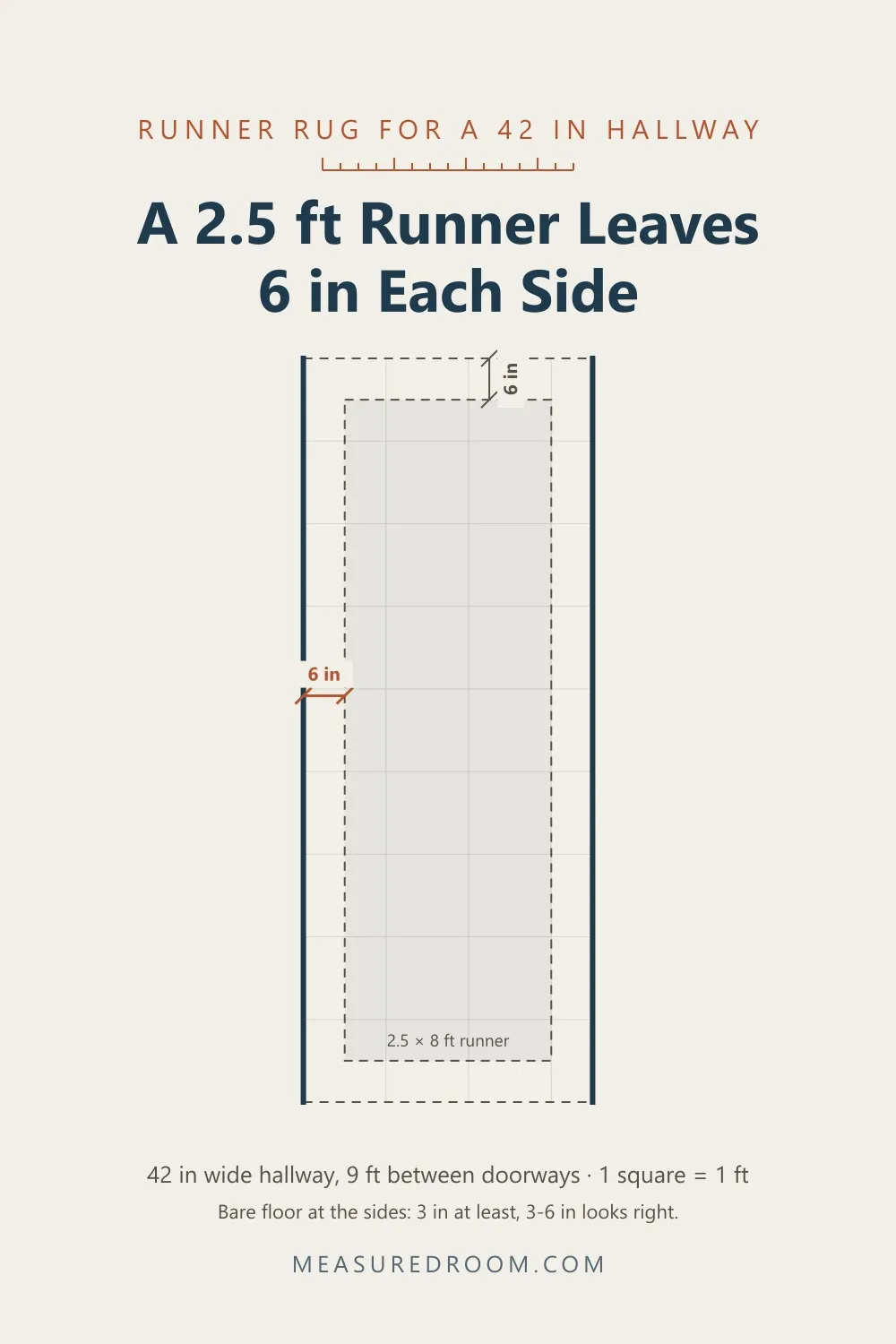
Take a 42 in hallway, a common hallway width, and a runner sold as 2.5 ft — 30 in wide. 42 − 30 = 12 in, which is 6 in each side. That is the top of the range, and it looks right.
The hallway is 9 ft between doorways, so the same 2.5 × 8 ft runner leaves 6 in at each end too: 108 − 96 = 12. That hallway is the easy case. Most aren’t.
The same runner, a 36 in hallway
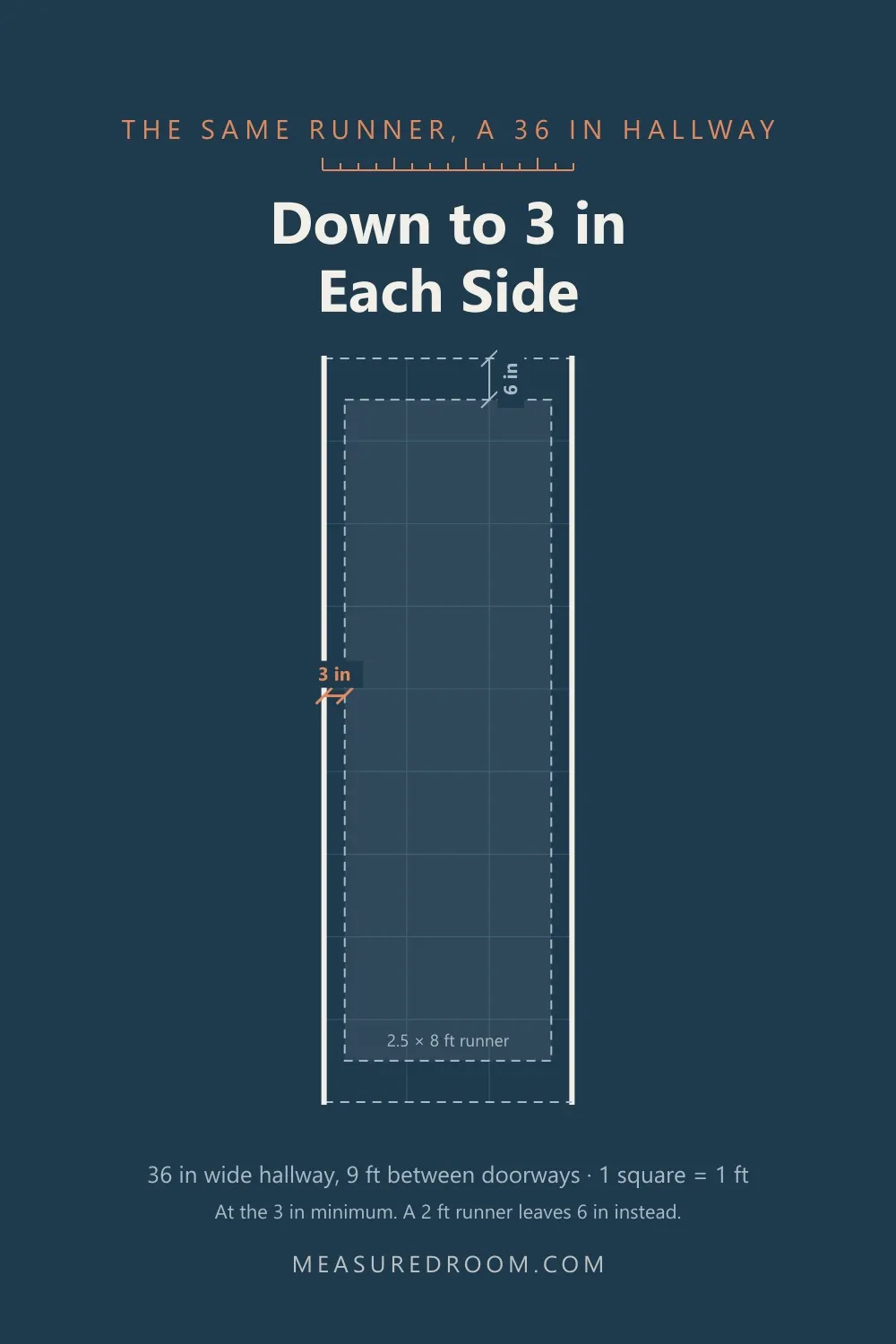
Move the same runner into a 36 in hallway. 36 − 30 = 6 in, so 3 in a side — the minimum, with nothing to spare. A 2 ft runner leaves 6 in instead.
Width is the forgiving direction, because the three stock widths are close together:
| Hallway | 2 ft runner (24 in) | 2.5 ft runner (30 in) | 3 ft runner (36 in) | Width for 4.5 in a side |
|---|---|---|---|---|
| 36 in | 6 in — fits | 3 in — fits | 0 in — too tight | 27 in |
| 40 in | 8 in — too much | 5 in — fits | 2 in — too tight | 31 in |
| 42 in | 9 in — too much | 6 in — fits | 3 in — fits | 33 in |
| 48 in | 12 in — too much | 9 in — too much | 6 in — fits | 39 in |
| 54 in | 15 in — too much | 12 in — too much | 9 in — too much | 45 in |
Floor left at each side. Every hallway up to 48 in has a stock width that fits. At 54 in nothing does: the widest common runner, 3 ft, leaves 9 in a side, and the hallway starts to look like it has two aisles.
The width that lands in the middle of the range — 4.5 in a side — is the last column: hallway width minus 9 in. For 42 in that is 33 in, and Sisal Rugs Direct’s own guide arrives at the same place, a 32 or 34 in runner for a 42 in hallway.
The length: where stock sizes give out
The runners sold in every shop come in a handful of lengths. Sisal Rugs Direct’s guide names the common ones: 6, 8, 10 and 12 ft. Each of them fits a hallway only in a narrow band — the runner plus 8 in (4 at each end) up to the runner plus 16 in (8 at each end).
| Stock runner | Fits a hallway of |
|---|---|
| 6 ft (72 in) | 80–88 in |
| 8 ft (96 in) | 104–112 in |
| 10 ft (120 in) | 128–136 in |
| 12 ft (144 in) | 152–160 in |
Now look at what falls between the bands: 89–103 in, 113–127 in and 137–151 in. Between 80 and 160 in, the four stock lengths fit 32 of those 80 inches. A hallway picked at random is more likely to miss than to fit.
A 10 ft hallway: no stock length fits
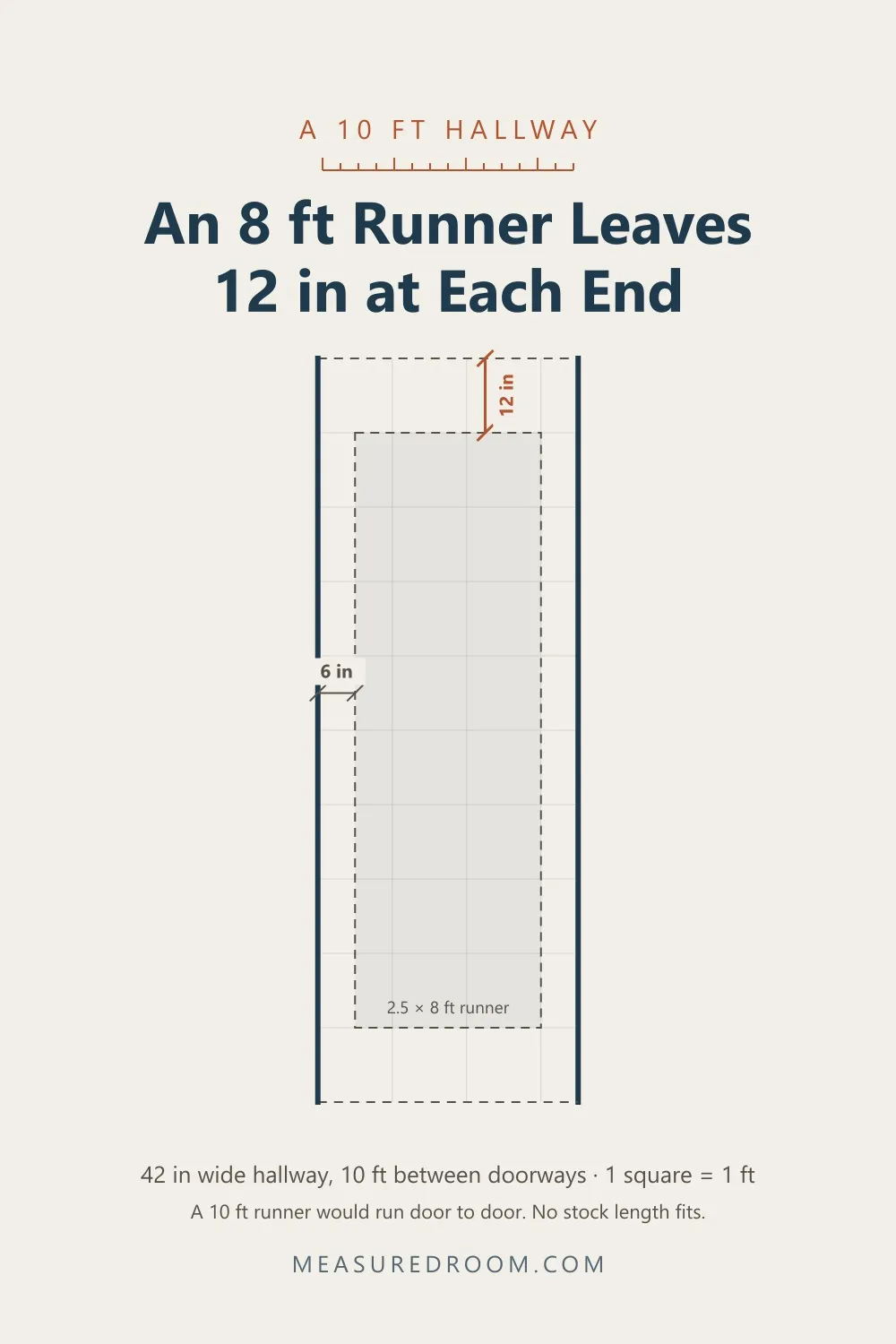
Here is one of the misses. A 42 in hallway, 10 ft between doorways. The 2.5 × 8 ft runner leaves 12 in at each end — 50% more than the 8 in limit. The 10 ft runner is exactly as long as the hallway, so it runs into both thresholds.
Neither is a disaster, and if you have to choose, the short one is the one to choose: floor that shows is a look, a runner that rucks up under a door is a trip hazard. But this is the case where the length you need is not on the shelf.
Or have it cut
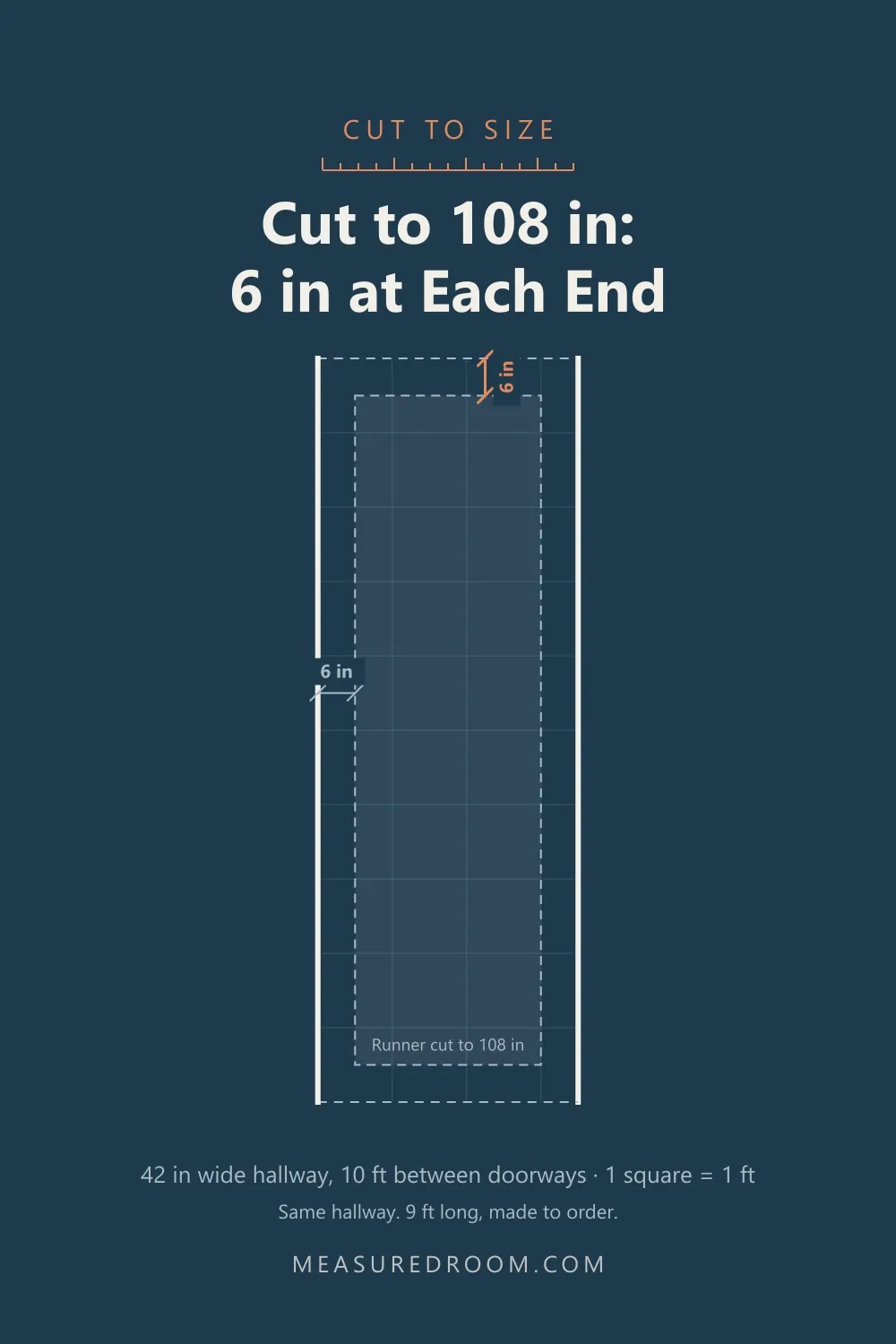
The length that lands in the middle of the range is the hallway minus 12 in. For 120 in, that is a runner cut to 108 in — 9 ft. 6 in at each end, 6 in each side.
Sisal Rugs Direct makes every hallway runner to order: you choose the length, the width and the border, and it is priced by the square foot. That is the answer for a 9 ft hallway, and for a 54 in-wide one too — a 45 in runner exists only if someone cuts it.
If you would rather shop finished rugs, Rug Source lists thousands of runners, and many of them are not stock sizes at all — handmade and vintage pieces measured as they are, at lengths like 9 ft 6 in or 11 ft 2 in. Search by the length you worked out, not by the size label. A 9 ft 6 in runner in our 10 ft hallway leaves 3 in at each end; one around 9 ft lands in the range.
The kitchen: the same math, from the counters
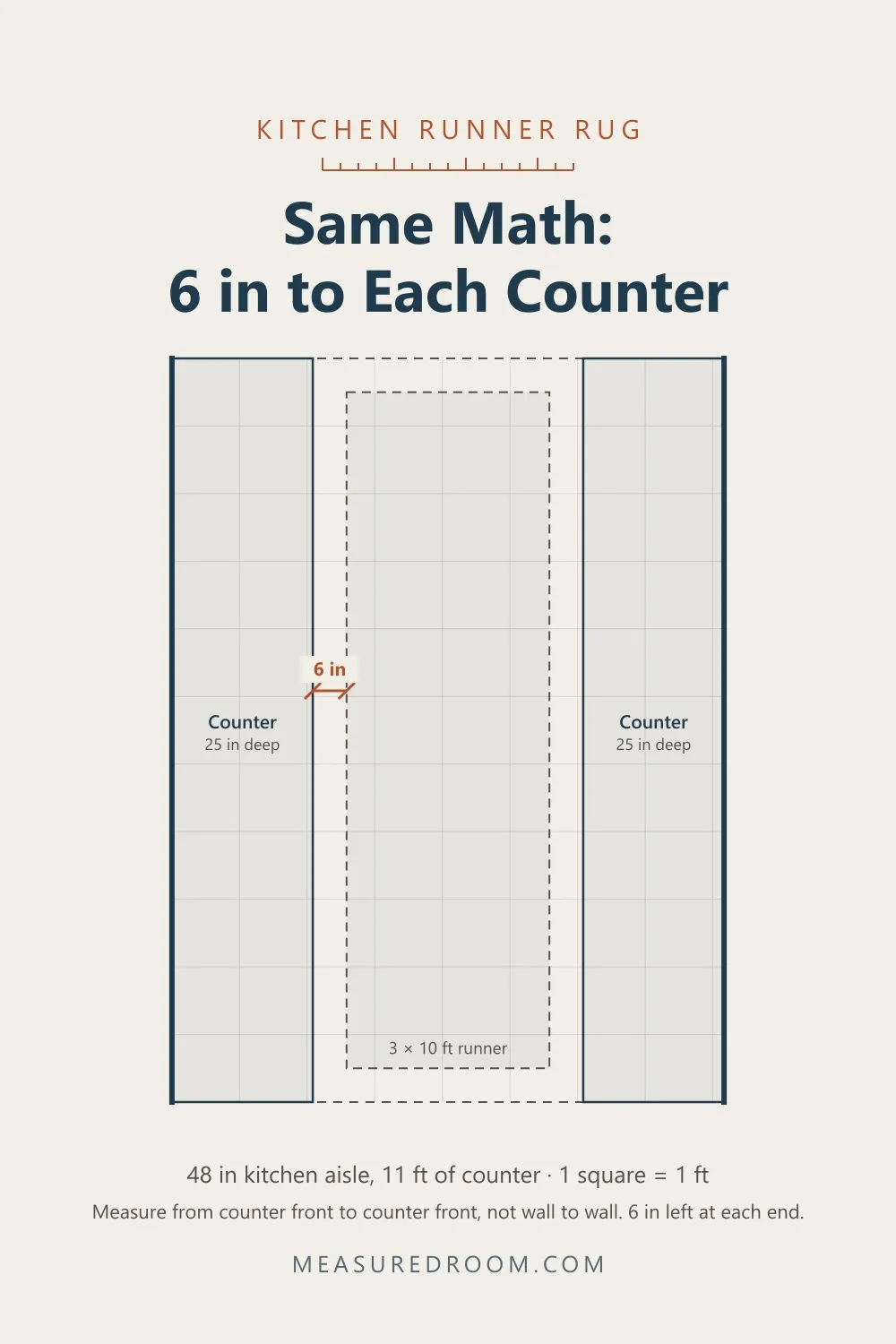
A kitchen runner is sized exactly like a hallway runner, with one difference: you measure from counter front to counter front, not wall to wall. The cabinets’ toe kicks are already set back; the counter edge is where your feet stop.
In a 48 in aisle, a 3 ft runner leaves 6 in to each counter. With 11 ft of counter, a 10 ft runner leaves 6 in at each end. Sisal Rugs Direct’s guide asks for 4 to 6 in all round in a kitchen — the tighter half of the hallway range, because the runner sits right where you stand to cook. If you want the middle of the range, the table above already has the number: 39 in for a 48 in aisle.
What does change in a kitchen is the material. Sisal and seagrass take hallway traffic well, but a dropped sauce goes into the weave. In front of the sink and the stove, a flat-woven or washable runner is easier to live with; Rug Source’s range is wide enough to filter the stock sizes by that first.
The rule
Width: hallway width minus 9 in. Length: hallway length minus 12 in. That is 4.5 in at each side and 6 in at each end — the middle of both ranges. Then look for the stock size within 3 in either way of the width, and within 4 in of the length. If there isn’t one, that is a runner to have cut.
The rule is the same one we use for rugs under a sofa and under a dining table: decide how much floor or rug should show, then subtract. Never start from the size label.
Before you order a runner
- Measure the clear width. Wall to wall in a hallway, counter front to counter front in a kitchen. Skip the baseboard; measure at floor height.
- Measure the run between doorways. Not to the far end of the next room — to the thresholds, because that is where the runner has to stop.
- Check the doors. A door that swings over the runner needs clearance under it. A thick pile can stop a door with a low gap.
- Work the two numbers. Width minus 9, length minus 12.
- Check the real size. A runner sold as 8 ft can measure an inch or two short. At the ends, 2 in is a third of your margin.
Runner rug measuring sheet
10 items · 3 categories
Runner rug measuring sheet — measuredroom.com
Inches throughout. Measure at floor height.
The space
- Clear width (in) — wall to wall, or counter to counter
- Length between doorways (in)
- Doors that swing over it, and the gap under each (in)
The runner
- Width: clear width − 9 in (3 to 6 in each side)
- Length: run − 12 in (4 to 8 in each end)
- Nearest stock size, and what it leaves at each side and end
- Actual size from the listing (in)
If no stock size fits
- Cut length and width to order (in)
- Border or binding
- Kitchen: washable or flat-woven in front of the sink and stove?
The short version: a 2.5 ft runner for a 36 to 42 in hallway, a 3 ft runner for a 42 to 48 in one, and a length 12 in shorter than the hallway — cut to order when the hallway falls between the stock sizes, which most do. Where the runner meets a front door, see entryway door swings; and if the hallway is also the way the sofa comes in, measure it once for both with the delivery route checklist.