Rug Sizes Under a Dining Table: The 24-Inch Rule
DisclosureThis page contains affiliate links. If you buy through them, we may earn a commission at no extra cost to you.
There is one failure mode for a rug under a dining table, and everybody has sat on it: you lean back, the chair’s rear legs drop off the edge of the rug, and the chair tips. That is not a rug that is slightly too small. It is a rug sized to the wrong object.
The table is not what the rug is for. The rug is sized to the chairs, pulled out, and the number that does it is 24 in past the table edge on every side.
Why 24 inches
A dining chair moves back about 20 in from the table edge for someone to sit down, and a little further for someone to stand up. The rear legs travel with it. Add a couple of inches so the legs land on rug rather than on the binding, and 24 in is the working figure on every side of the table.
Thirty-six inches is the more generous version, and it matches the pass-behind clearance a dining room wants anyway. In most apartment dining areas that size of rug does not exist in the sizes rugs are sold in, which is the real constraint here: rugs come in a short list of fixed sizes, and the arithmetic has to land on one of them.
Anything under 24 in and the chair legs cross the edge in ordinary use. It is the same failure as a coffee table with two legs on a rug and two off, except this one moves, several times a meal.
The size, by table
Take the table’s footprint and add 48 in to each dimension — 24 in on each side — then find the first standard rug that covers it.
| Table | Rug must cover | Smallest standard size |
|---|---|---|
| 48 × 30 in | 96 × 78 in | 8 × 10 (120 × 96 in) |
| 60 × 36 in | 108 × 84 in | 8 × 10 (120 × 96 in) |
| 72 × 36 in | 120 × 84 in | 8 × 10 (120 × 96 in) |
| 84 × 40 in | 132 × 88 in | 9 × 12 (144 × 108 in) |
| 60 in round | 108 in across | 9 × 12, or a 9 ft round |
Table not on the list? The dining rug size calculator runs the same arithmetic for any table, draws it to scale with the chairs pulled out, and checks the rug against your room.
Note what the table says about the 8 × 10. It is the workhorse size here — it covers everything up to a 72 in table — and it is also the size that fails a 6 × 9 room, because a 10 ft rug needs a room wider than 10 ft to leave any floor at all.
For round tables, a round rug is the tidier answer and needs the diameter plus 48 in: a 48 in round table wants an 8 ft round, a 60 in round table wants a 9 ft.
Two rugs, one table
An 11 ft × 10 ft dining room — the same room as the dining table sizing guide — with a 72 × 36 in table centered. The table does not move between these two plans. Only the rug does.
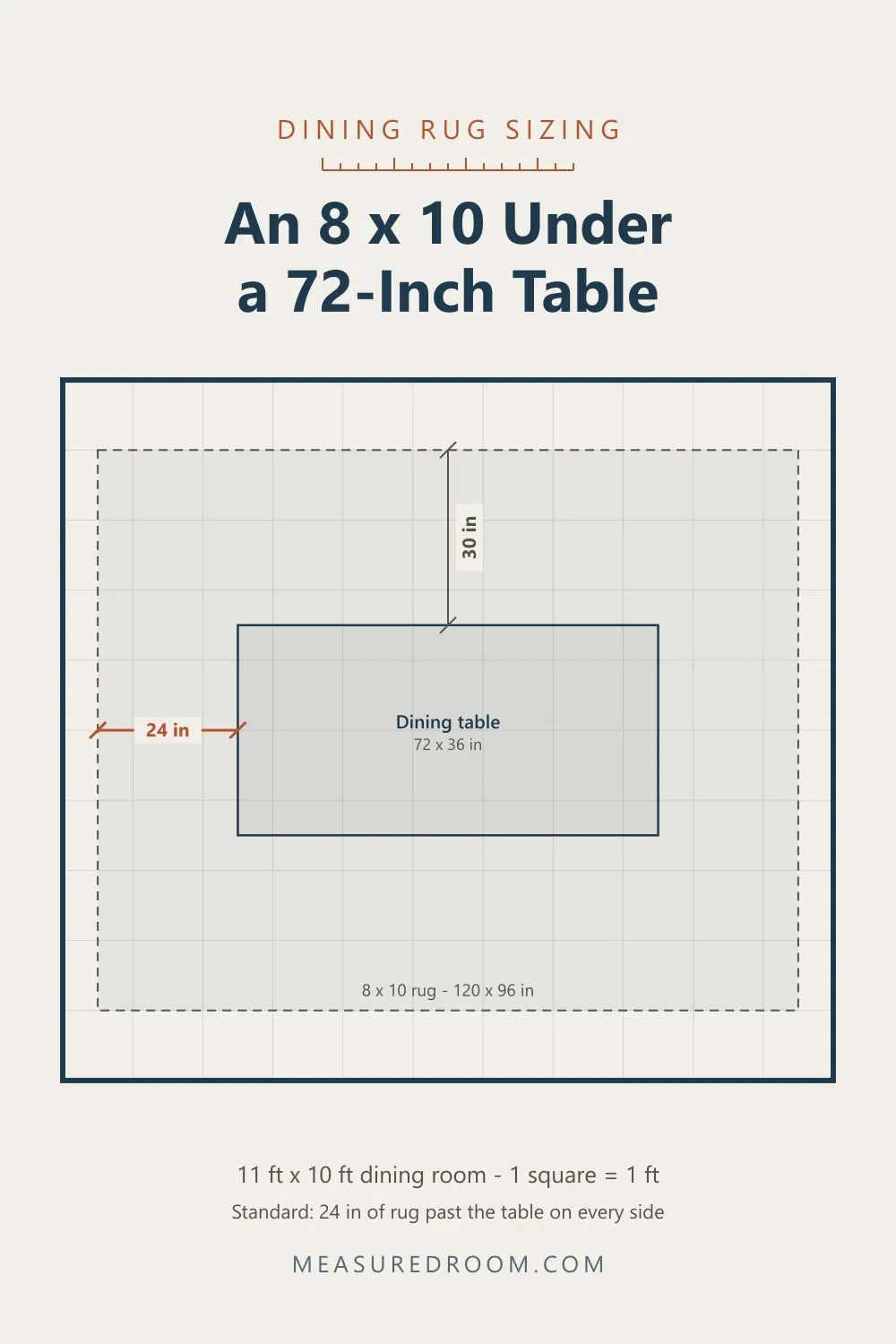
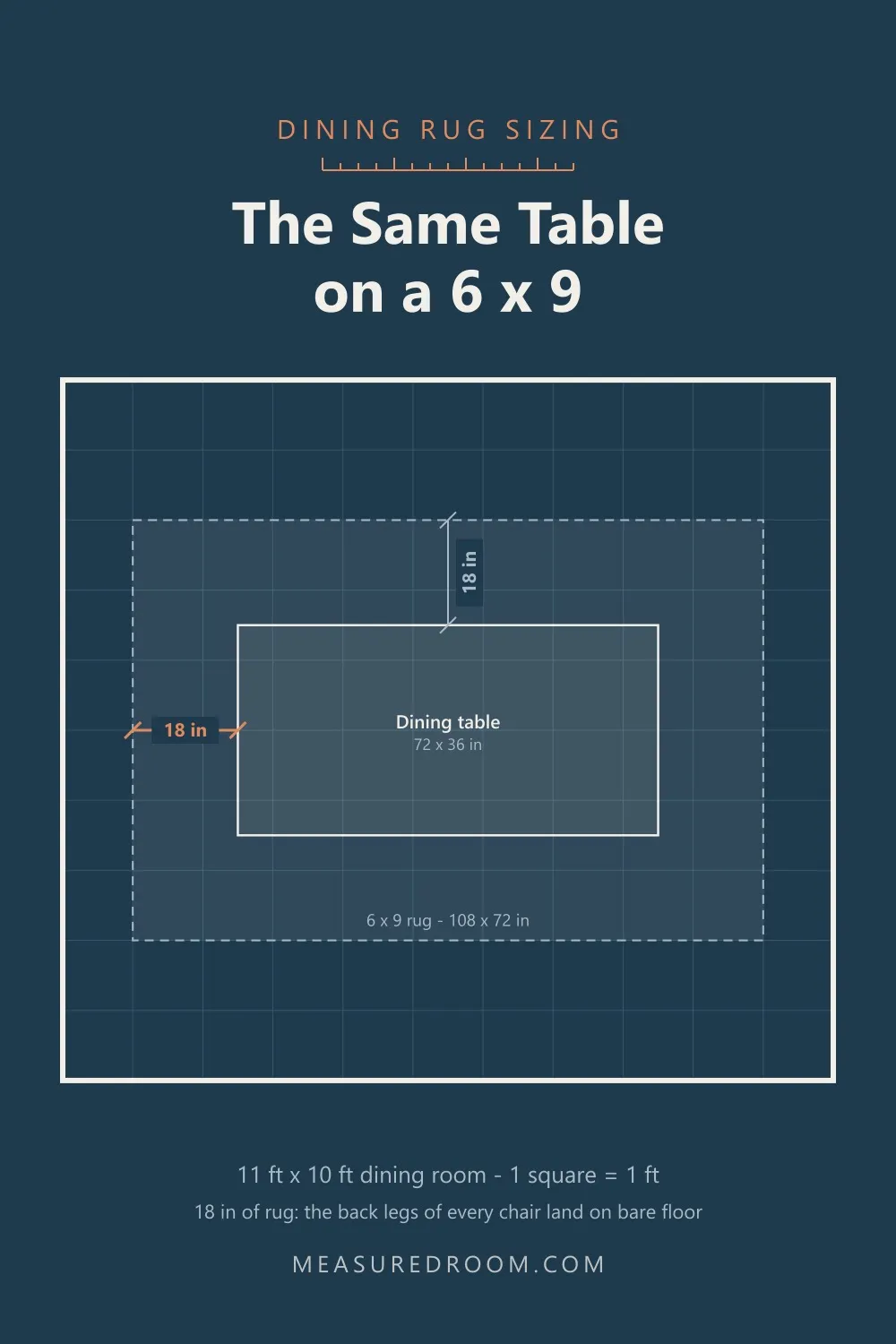
Measured off the drawings, not estimated by eye:
| 8 × 10 rug | 6 × 9 rug | |
|---|---|---|
| Rug past the ends of the table | 24 in | 18 in |
| Rug past the sides of the table | 30 in | 18 in |
| Chairs stay on when pulled out | Yes | No |
| Bare floor left at the walls | 6 in / 12 in | 12 in / 24 in |
Six inches of rug per side is the entire difference, and it is the difference between a room that works and a room where four chairs catch on an edge every evening.
The 6 × 9 has the better-looking floor. It leaves a visible border of bare wood all the way round, which is what a rug guide written about living rooms would tell you to aim for. Under a dining table that border is the thing you trip the chairs on.
When the room is too small for the right rug
Three real options, in the order worth trying them.
Go down a table size. A 60 in table on an 8 × 10 has 30 in of rug at the ends instead of 24, and gives you the pass-behind clearance at the same time. It is the same fix for both problems.
Skip the rug. A dining rug is the one rug with an argument against it: it catches crumbs, it catches chair legs, and it is under the part of the house that gets the most spills. In a room that cannot take a correctly sized one, no rug is a better answer than a small one.
Use a flatweave or an indoor-outdoor rug. If the rug is going in anyway, pile height is the other half of the problem — chairs drag on anything with a pile, and a low flatweave lets them slide.
Before you buy
Measure the table, add 48 in to both dimensions, and check that number against the rug sizes that actually exist — not against a range. Then measure the room and subtract: if the rug leaves under six inches of floor at a wall, it is too big for the room even though it is right for the table, and you are back to a smaller table.
Article lists exact rug dimensions rather than nominal ones, which matters more here than it looks: a rug sold as 8 × 10 is often 94 × 118 in rather than 96 × 120, and this calculation has only six inches of slack in it.
Choose the size first and the material second. Under a dining table that means low pile or flatweave, so chair legs slide rather than catch, and something that survives a dropped plate — which rules out sisal. Rug Source carries enough of a range that you can shop by the size you just worked out and still have a real choice of material inside it.

The short version
Table footprint, plus 48 in in both directions, rounded up to a rug size that exists. For most apartment dining tables that is an 8 × 10, and for anything from an 84 in table upward it is a 9 × 12.
If the room cannot take that rug, the answer is a smaller table or no rug — not a smaller rug.