Rug Sizes Under a Sofa: What Actually Anchors a Room
DisclosureThis page contains affiliate links. If you buy through them, we may earn a commission at no extra cost to you.
Almost every rug guide starts with the wrong question. It asks how big your rug should be, offers a range, and leaves you to work out which end of it you are on.
The size is not the first decision. The first decision is which legs of the sofa sit on the rug — the front two, or all four. Settle that, and the size stops being a matter of taste. It becomes arithmetic you can do with a tape measure and the width of the sofa you already own.
The question isn’t “how big,” it’s “which legs”
Two placements are in common use, and they are not two grades of the same idea. They ask the rug to do different jobs.
Front legs only. The rug starts somewhere under the front of the sofa and runs out into the room. The back legs stay on bare floor against the wall, where nothing is looking at them.
All four legs on. The rug starts at the wall, or close to it, and the whole sofa stands on it.
Everything else follows from that. Which one you pick sets the minimum width, sets the minimum depth, and — because rugs are sold in a short list of fixed sizes — usually sets the price too. It is the same order of operations as sizing a sectional against the room: decide the arrangement first, and let the dimensions fall out of it.
Front legs only: what has to reach the rug
Two things, and only two.
The front legs have to be on it. Not near it. On it. A sofa with two legs on the pile and two on bare floor sits level only because the pile is thin, and a thick rug with no pad under the sofa front will rock.
The coffee table has to be on it too, entirely. This is the condition people miss, and it is the one that sets the depth. A coffee table with two legs on and two off is what makes a room look unfinished, because unlike the sofa, you can see all four of its legs.
Width is the easier of the two. Run the rug at least 6 in past each arm — call it sofa width plus 12 in — or it reads as a mat someone slid under the furniture rather than a floor the furniture is standing on.
All four legs on: what changes
The width rule tightens, and the depth rule takes over.
Width: at least 12 in past each arm, so sofa width plus 24 in. With all four legs on, the border you actually see runs along the sides of the sofa rather than only in front of it, and six inches of border beside an 84-inch sofa looks like a miscalculation.
Depth: the rug has to start at the wall and finish past the coffee table. That is one uninterrupted number, and it is a big one. In the plan below the far edge of the coffee table is 84.5 in from the wall, so the rug needs roughly 90 in of depth before the arrangement looks deliberate.
Ninety inches of depth is what quietly disqualifies the small sizes. It is not the sofa that rules them out. It is the coffee table sitting three feet in front of it.
Same room, two placements
Same room as the $3,000 living room: 15 ft wide by 12 ft deep. Same 83 × 35 in sofa on the long wall, same 31.5 in round coffee table, same 18 in gap between them. The furniture does not move between these two plans. Only the rug does.
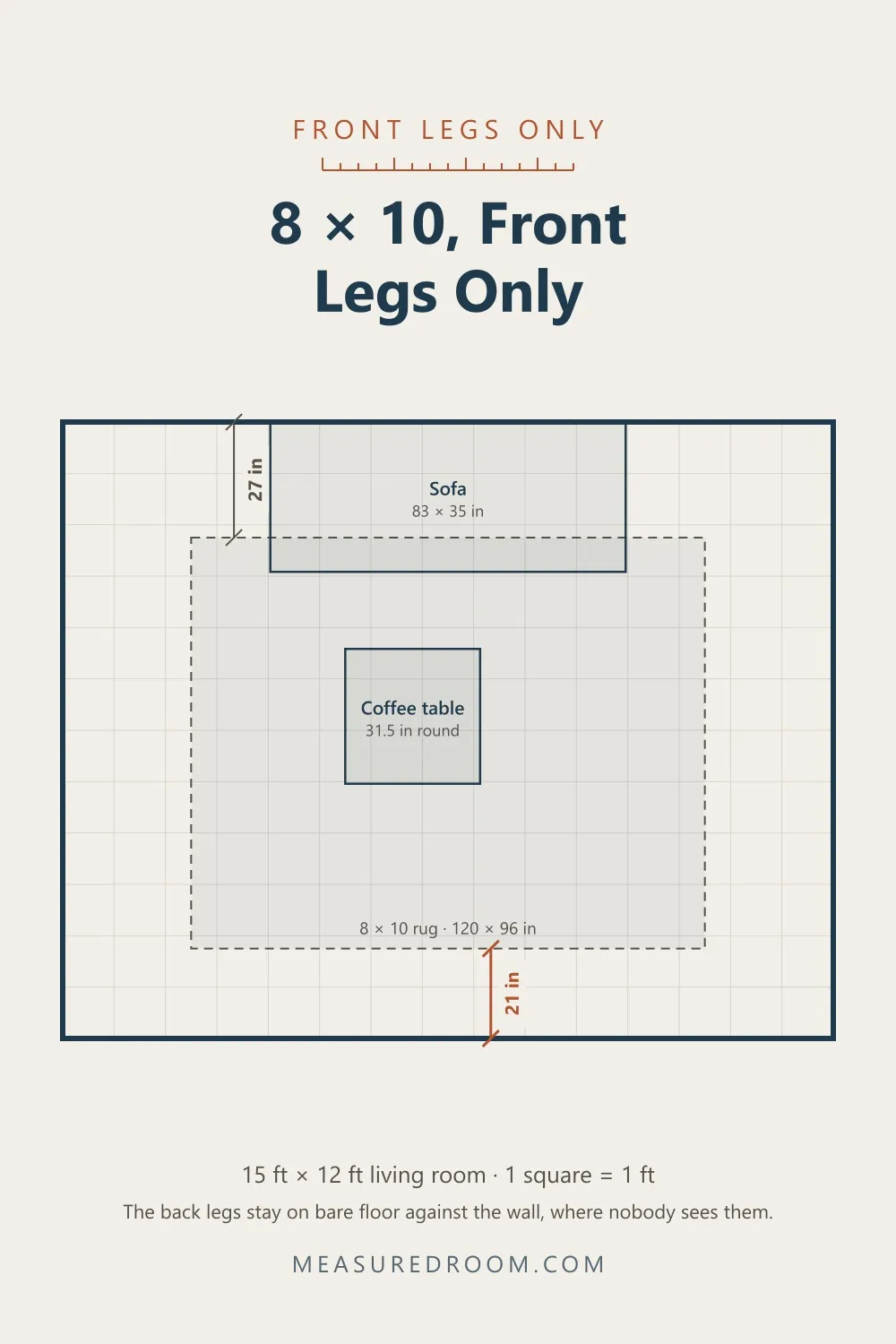
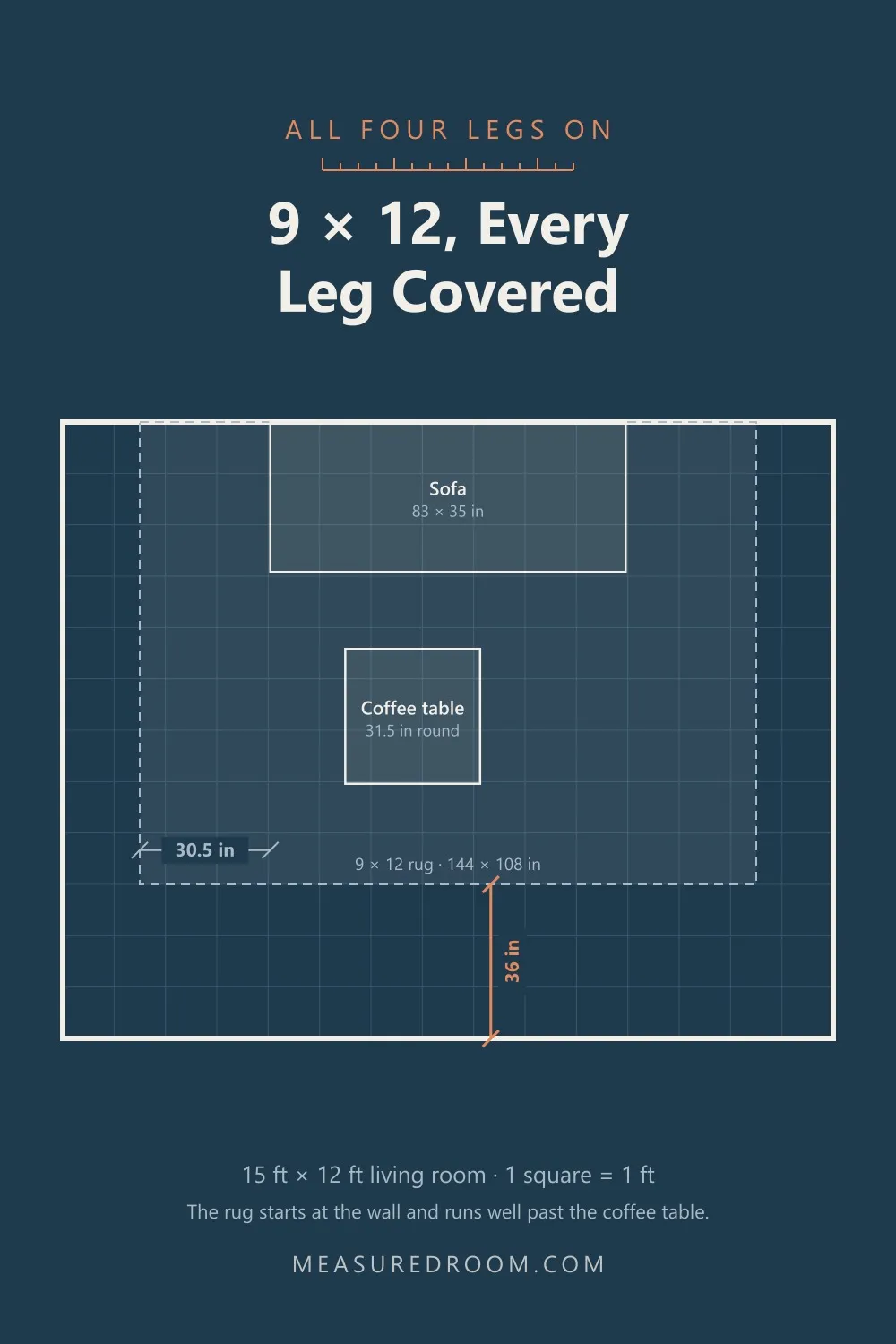
Measured off the drawings, not estimated:
| Front legs only, 8 × 10 | All four legs on, 9 × 12 | |
|---|---|---|
| Rug | 120 × 96 in | 144 × 108 in |
| Rug past each arm | 18.5 in | 30.5 in |
| Bare floor, each side wall | 30 in | 18 in |
| Bare floor at the far wall | 21 in | 36 in |
| Rug hidden under the sofa | 664 sq in (5.8%) | 2,905 sq in (18.7%) |
Read the last row before you read anything else. All four legs on puts nearly a fifth of the rug under the sofa, where nobody will see it again until you move. That is not an argument against it. It is the thing you are buying, and it is worth knowing that you are buying it.
The version nobody prices out
Here is the part that surprised us when we drew it. You do not need a bigger rug to get all four legs on. In this room you need the same rug, slid back to the wall.
Take the 8 × 10 from the first plan and start it at the wall instead of 27 in out. It is 96 in deep and the coffee table ends at 84.5 in, so it clears the table by 11.5 in. Its width puts 18.5 in of rug past each arm, comfortably past the 12-inch rule. All four legs are on, and there is still 48 in of bare floor at the far wall.
Cost of that upgrade: nothing. You already own the rug.
The 9 × 12 does buy something real over it — 30.5 in of rug past each arm instead of 18.5, and a border that stays generous when you add a chair. But if the reason you were about to size up was “I want all four legs on,” check the arithmetic on the rug you already have first.
One correction while we are here. In the $3,000 build we called the 9 × 12 the wrong rug for this room, because it left only 9 in of bare floor at the far wall. That was true of that placement — the rug was set out from the wall for a front-legs layout, which pushes all 108 inches of it into the room. Started at the wall, the same rug leaves 36 in. The rug did not change. The placement did, and the placement was worth 27 inches of floor.
Which standard size clears your sofa
Rugs are named in feet and sold in a short list, so this reduces to a lookup. Apply the two rules — sofa width plus 12 for front legs only, plus 24 for all four — to each standard size laid with its long side along the sofa wall:
| Standard size | Actual dimensions | Widest sofa, front legs only | Widest sofa, all four legs on |
|---|---|---|---|
| 5 × 8 | 96 × 60 in | 84 in | — too shallow |
| 6 × 9 | 108 × 72 in | 96 in | — too shallow |
| 8 × 10 | 120 × 96 in | 108 in | 96 in |
| 9 × 12 | 144 × 108 in | 132 in | 120 in |
| 10 × 14 | 168 × 120 in | 156 in | 144 in |
The two dashes are the finding. In a room with a coffee table, choosing all four legs on deletes the two smallest rug sizes from your options, whatever your sofa is. A 5 × 8 is 60 inches deep and a 6 × 9 is 72; neither reaches the far side of a coffee table set 18 inches off the sofa. The floor of the range is the 8 × 10.
Two things this table is not. It is not a manufacturer’s recommendation — the plus-12 and plus-24 rules are ours, taken from the border widths that read as deliberate rather than accidental. And it assumes the long side runs along the sofa wall, which is the usual orientation and not the only one. Turn a 9 × 12 ninety degrees and you have a 108-inch wall run with 144 inches of depth, which is the right answer in a long narrow room and the wrong one nearly everywhere else.
What the step up actually costs
Rug prices move in size steps, so “one size up” is a specific number rather than a feeling. Article publishes the Clyde wool rug in three sizes and a matching pad in four. Read on 5 September 2026:
| 5 × 8 | 8 × 10 | 9 × 12 | |
|---|---|---|---|
| Clyde wool rug | $349 | $699 | $949 |
| Stein rug pad, ¼ in | $79 | $129 | $169 |
| Rug + pad | $428 | $828 | $1,118 |
Going from the 8 × 10 to the 9 × 12 is $290 once the pad is counted, which in that $3,000 room was more than the side table. Article also lists the 8 × 10 rug and pad together as a bundle at $828 — the two prices added up, with nothing gained or lost by buying them separately.
Two practical notes from the same product pages:
The standard sizes are a naming convention, not a promise that a given rug comes in all of them. Clyde is published in 5 × 8, 8 × 10 and 9 × 12 — there is no 6 × 9. Article does sell a 6 × 9 pad, so the size exists in the catalog, just not in that collection. If your arithmetic lands on a 6 × 9, check that the rug you like is actually made in one before you plan the room around it.
Buy the pad at the rug’s nominal size. The usual advice is to run a pad an inch or two under the rug so it cannot peek out. Article does not sell it that way: the Stein pad for an 8 × 10 rug is listed as 8 × 10, ¼ inch thick, 22 lb. Match the numbers rather than sizing down, and if you want the inset, trim it — a felt-and-latex pad cuts with scissors.
What you give up either way
A deeper rug eats the walkway at the far wall. In this 12-foot-deep room the 8 × 10 leaves 21 in of bare floor in a front-legs layout, 48 in pushed to the wall, and the 9 × 12 leaves 36 in. Thirty-six inches is the standard minimum for a main path through a room, so the 9 × 12 lands exactly on the line — fine in a room you walk across, tight in a room you walk through carrying things.
A wider rug eats the side margins. Thirty inches of bare floor beside the 8 × 10 becomes eighteen beside the 9 × 12. If a doorway opens into that side of the room, the rug edge has just moved into the traffic.
Both add weight to the delivery. The 8 × 10 pad on its own is 22 lb and the 9 × 12 is 29 lb, before the rug. It matters exactly once — the day it arrives and has to come up the stairs rolled.
Before you order
- Measure the room’s depth, not just its width. Width tells you whether the rug clears the sofa. Depth tells you whether it leaves a walkway, and depth is what decides between the 8 × 10 and the 9 × 12. Run the leftover against the 36-inch minimum the same way you would for a sectional.
- Put the coffee table on the plan before you pick a size. All four legs on is a depth problem and the coffee table sets the depth. Decide where it sits, measure to its far edge, add a few inches, and that is your minimum.
- Check that the size exists in the rug you want. Standard sizes are a convention. Collections are not obliged to carry all of them.
- Think about the roll, not just the rug. A 9 × 12 arrives as one long heavy cylinder that has to make the same turns your sofa did. If your route was tight in the delivery checklist, it is tight for this too.
If you take one thing away: the placement decides the size, not the other way round. Front legs only will let you into a 5 × 8 or a 6 × 9. All four legs on starts at the 8 × 10 and does not go down from there. And before you pay $290 for the privilege, check whether the rug you were already going to buy gets all four legs on by moving twenty-seven inches closer to the wall.
Prices and product dimensions above are Article’s own published figures, read on 5 September 2026. Room and furniture dimensions are ours, drawn to scale and measured off the plan. Prices move — check the product page before you order.