Bedroom Rug Ideas, Measured: What Size Rug Goes Under a Queen and a King
DisclosureThis page contains affiliate links. If you buy through them, we may earn a commission at no extra cost to you.
Most bedroom rug ideas are photographs: a bed, a rug, good light. What the photo never tells you is the one thing you need before you order — how much rug is showing, beside the bed and past its foot, and which of the five sizes rugs are actually sold in gets you that.
That is a measurement, not a taste. So here it is in one room, with a real queen frame and a real king frame, every rug size laid under each.
The room and the beds
| Piece | Size | Source |
|---|---|---|
| Article Basi queen bed frame | 63 W × 83 D in | General dimensions on article.com |
| Article Basi king bed frame | 79 W × 83 D in | General dimensions on article.com |
| Lenia floating nightstand × 2 | 19.75 W × 15.25 D in | article.com |
| Bedroom | 14 × 13 ft | ours |
Two numbers in that table do all the work. The king is 16 in wider than the queen, and the same 83 in long. So a king asks for more rug across the bed, and exactly the same rug past the foot.
The rugs are measured at their nominal sizes — an 8 × 10 is 96 × 120 in. Real rugs are often an inch or two short of that; more on that at the end.
Where the rug starts
Every rug in this article starts at the same line: the front of the nightstands, 15.25 in from the wall. The nightstands stay off the rug, nothing sits half on the pile and half off it, and the rug runs under the bed from there.
That means 67.75 in of every rug is under the bed before any of it shows at the foot. The long side runs across the bed, which is the only way round that works for anything smaller than a 10 × 14.
Then two numbers decide whether the size is right:
- How much shows beside the bed. At least 18 in a side, so your feet land on rug when you get up. 24 in looks deliberate rather than just enough.
- How much shows past the foot. The same: 18 in at least, 24 in to read as a rug and not a mat that slid.
These are our rules, taken from the same border widths we use for rugs under a sofa. They are not a manufacturer’s recommendation.
A queen: the 8 × 10
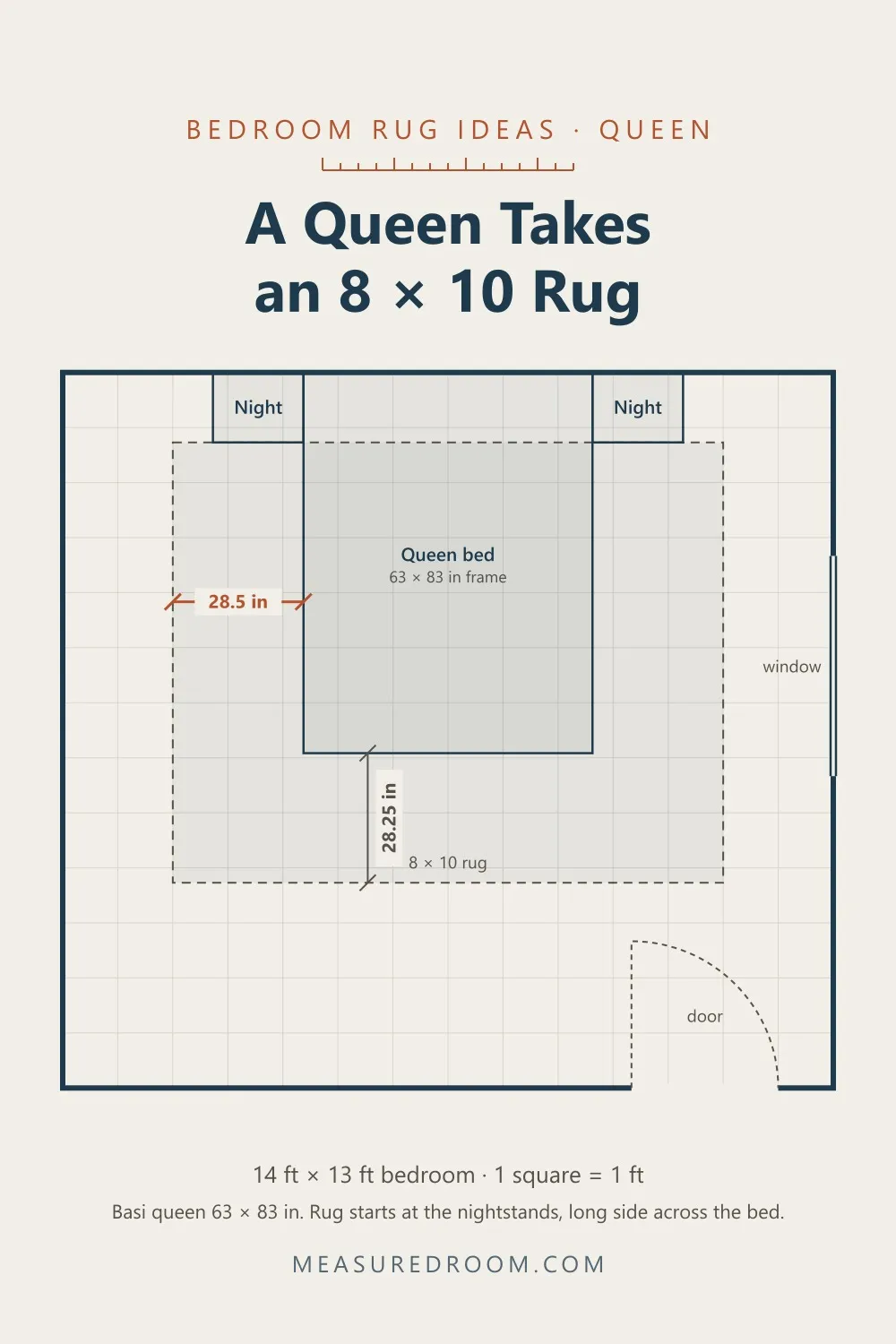
Laid across the bed, an 8 × 10 is 120 in wide against a 63 in frame. That is 28.5 in each side and 28.25 in past the foot — over 24 on both counts.
It does not leave the room short, either. In 14 × 13 ft there are 24 in of bare floor between the rug and each side wall.
The price of it is hidden under the bed: 29.6 of its 80 square feet never show. That is true of every rug in this article, and it is why we worked out in the $2,000 bedroom that two runners can be the better buy. But if you want one rug under a queen, this is it.
Why not a 6 × 9
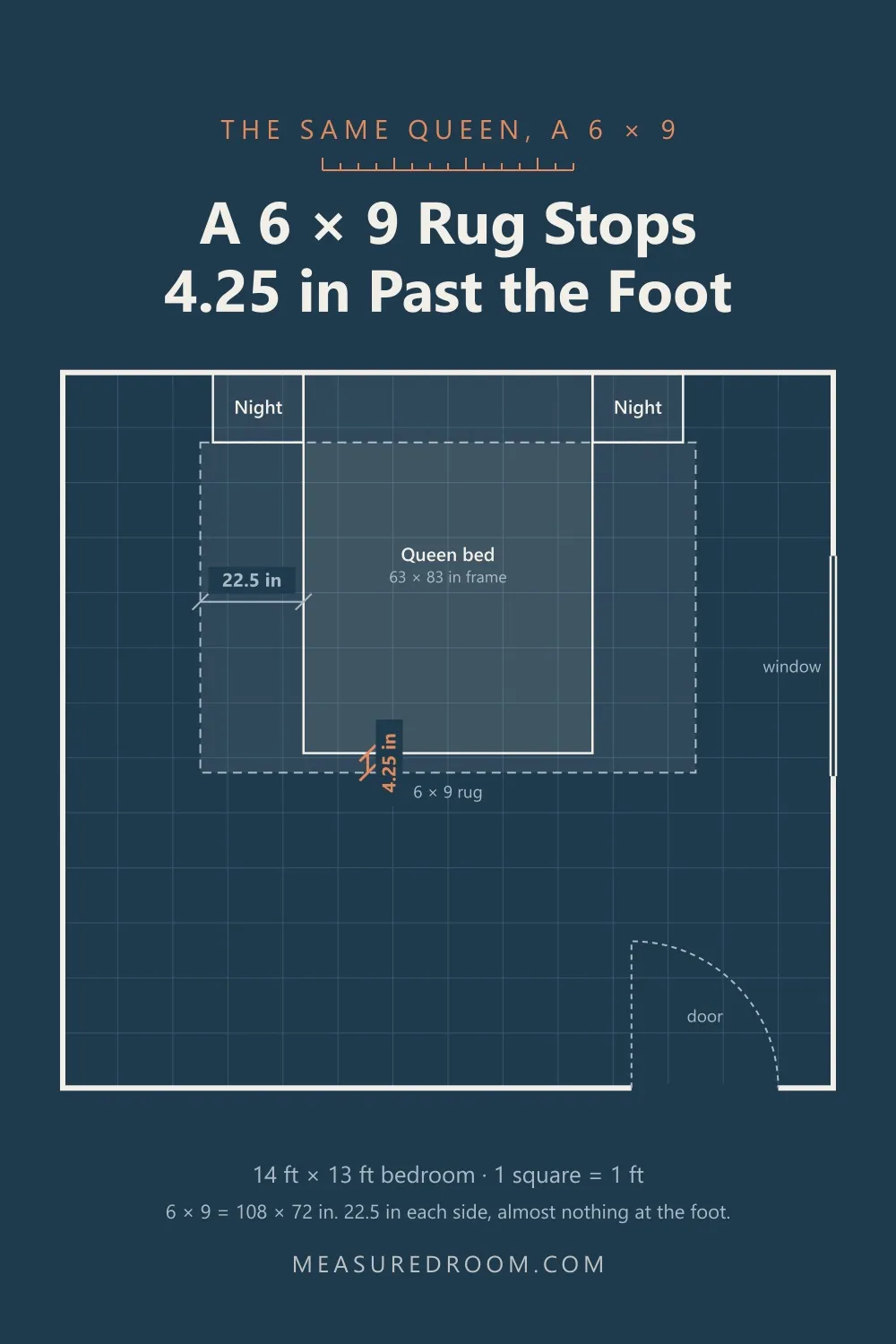
A 6 × 9 is the obvious way to save money, and from the side it nearly works: 22.5 in a side. Past the foot, it shows 4.25 in.
The problem is depth. A 6 × 9 laid across the bed is only 72 in deep, and 67.75 of that are under the bed. Turn it the other way and it is 72 in across a 63 in bed: 4.5 in a side. Either way round, one edge is a stripe.
A king: the 8 × 10 is the minimum
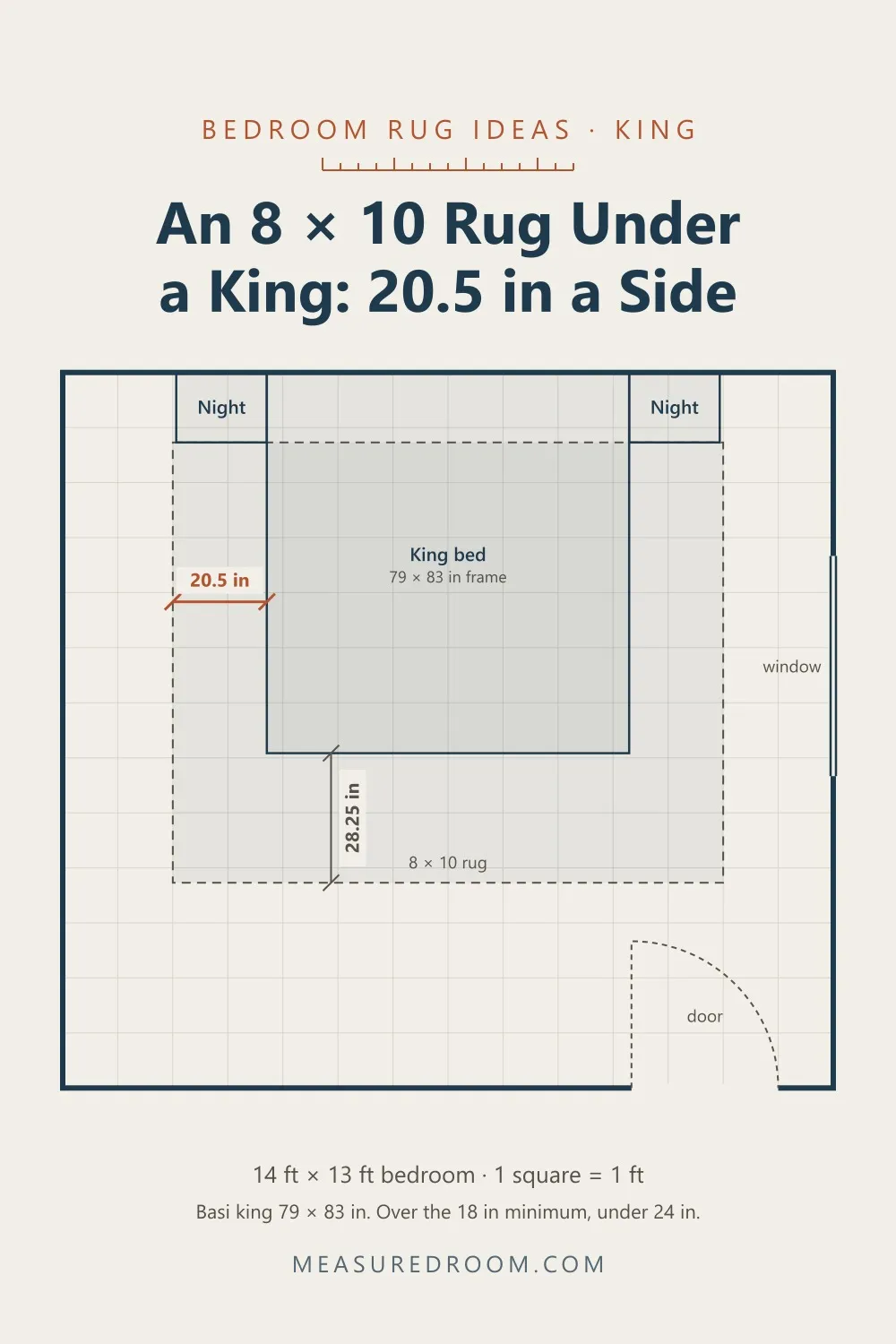
Put the same 8 × 10 under the king. The foot does not change — 28.25 in, because the king is no longer than the queen. The sides drop to 20.5 in: the king’s extra 16 in, eight taken from each side.
That passes the 18 in minimum and misses the 24. It is a rug you step onto in the morning, just. In a small room where a 9 × 12 will not fit, it is the right answer, not a compromise.
A king: the 9 × 12
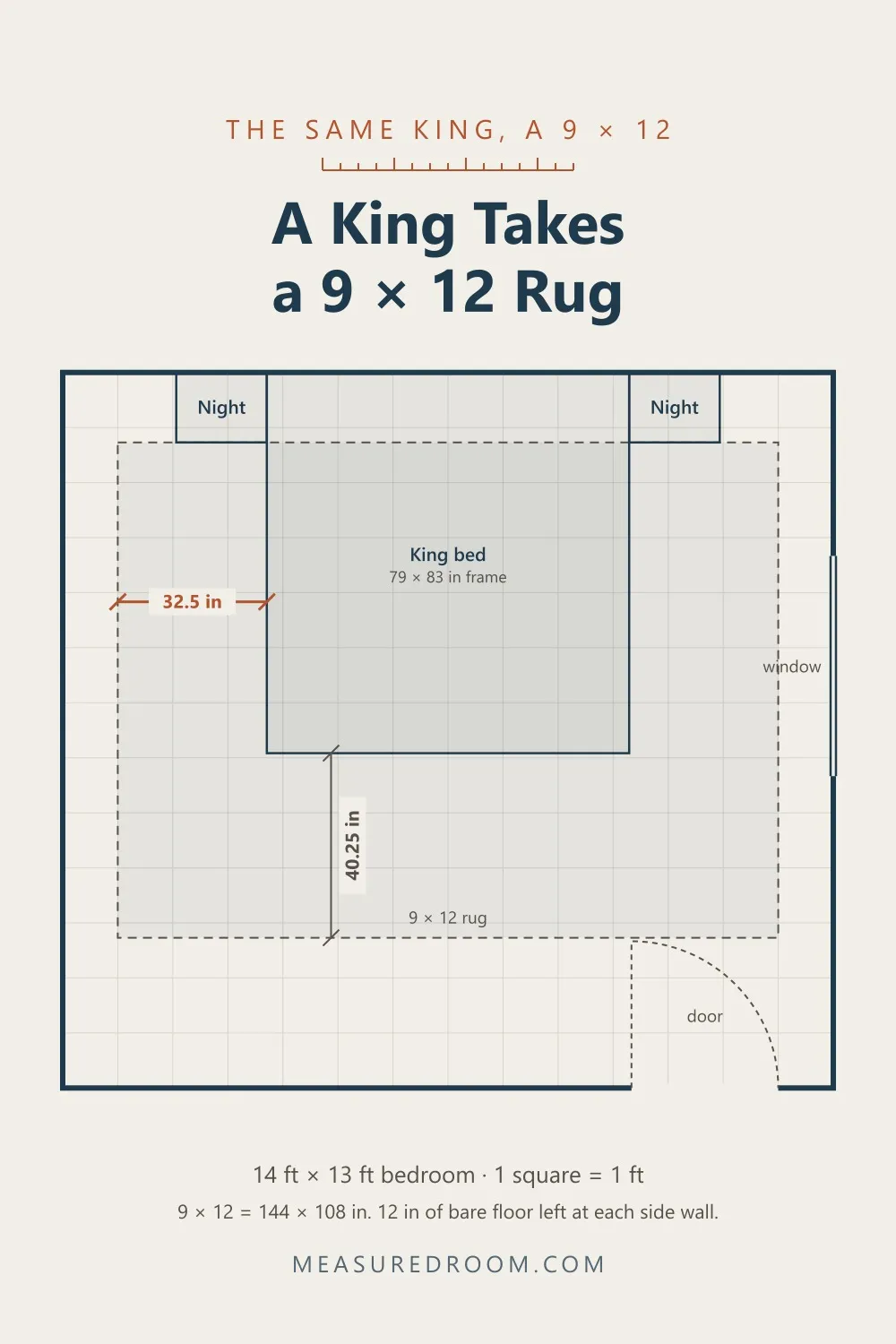
A 9 × 12 is 144 in across. 32.5 in each side and 40.25 in past the foot — more than enough on both counts. 37.2 of its 108 square feet go under the bed, a smaller share than the queen’s 8 × 10 loses.
Now watch the room instead of the bed. In 14 ft, the 9 × 12 leaves 12 in of bare floor at each side wall, and 32.75 in between its far edge and the foot wall. Twelve inches is about the least floor that still frames a rug; any narrower a room, and the rug starts to look like carpet that stopped short.
Every size, both beds:
| Rug | Queen: side / foot | Queen | King: side / foot | King |
|---|---|---|---|---|
| 5 × 8 | 16.5 / -7.75 in | too small | 8.5 / -7.75 in | too small |
| 6 × 9 | 22.5 / 4.25 in | too small | 14.5 / 4.25 in | too small |
| 8 × 10 | 28.5 / 28.25 in | good | 20.5 / 28.25 in | minimum |
| 9 × 12 | 40.5 / 40.25 in | good | 32.5 / 40.25 in | good |
| 10 × 14 | 52.5 / 52.25 in | good | 44.5 / 52.25 in | good |
A minus at the foot means the rug ends under the bed. A 5 × 8 is 60 in deep: it stops before the mattress does. And the 10 × 14 is good under both beds and fits neither room — at 168 in, it is wall to wall in a 14 ft bedroom.
The rule
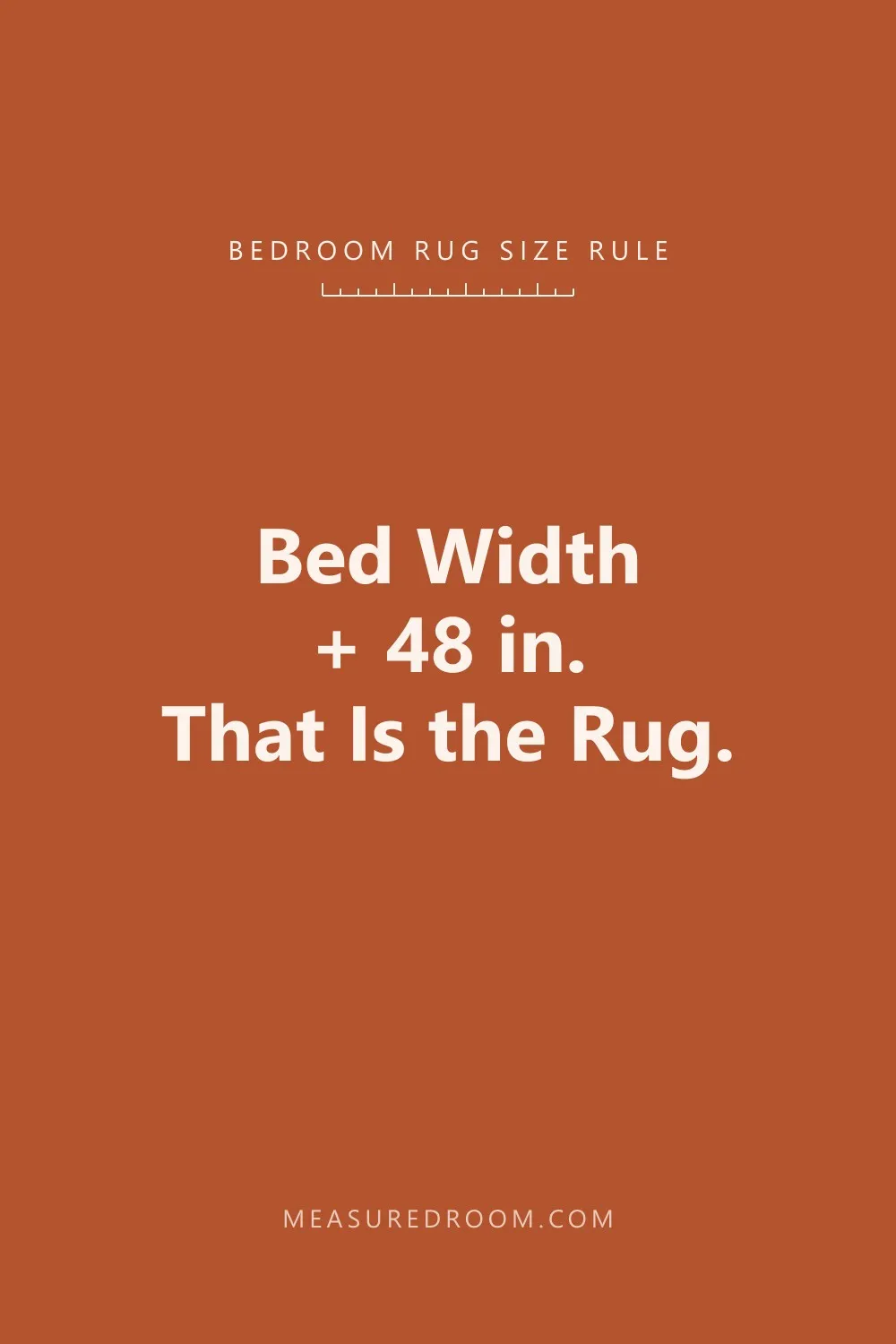
Across: frame width + 48 in. Deep: frame length − nightstand depth + 24 in. That gives 24 in on every side that shows. For the 18 in minimum, use 36 instead of 48 and 18 instead of 24.
For our beds:
| 24 in showing | 18 in showing | |
|---|---|---|
| Queen, 63 × 83 in | 111 × 92 in | 99 × 85.75 in |
| King, 79 × 83 in | 127 × 92 in | 115 × 85.75 in |
Then round up to a size that exists. The queen’s 111 × 92 rounds up to an 8 × 10. The king’s 127 × 92 does not round to anything sensible — it is wider than an 8 × 10 and a long way short of a 9 × 12.
Or have it cut
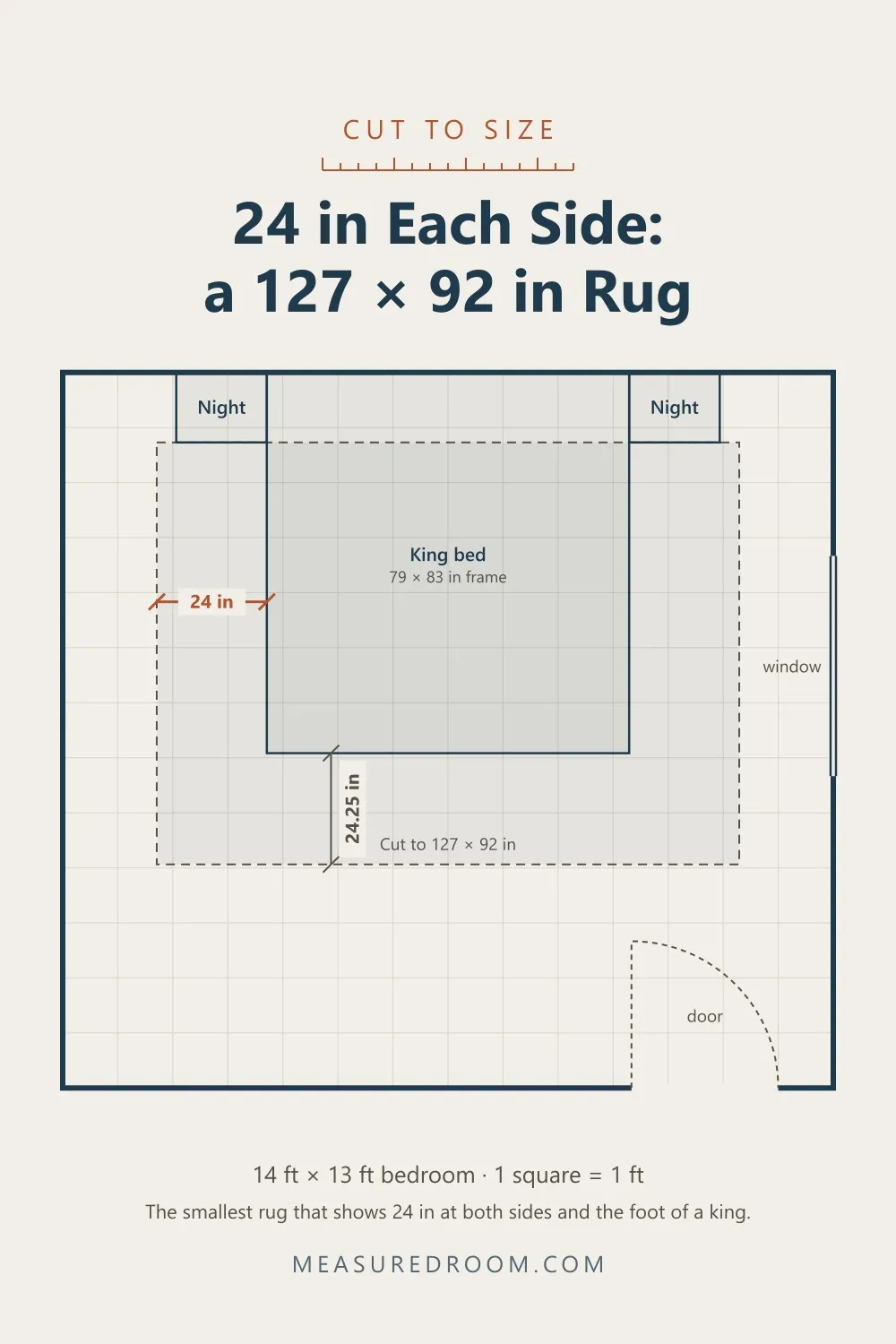
The standard sizes jump in big steps, and the king falls between two of them. The answer is the size the arithmetic gives: a rug cut to 127 × 92 in — 10 ft 7 in × 7 ft 8 in. 24 in at each side, 24.25 in past the foot, and 20.5 in of floor at each wall instead of 12.
For a queen, the same rule gives 9 ft 3 in × 7 ft 8 in, close enough to an 8 × 10 that cutting buys you little.
Sisal Rugs Direct cuts sisal and seagrass to the size you give it, which is what makes a 127 × 92 a thing you can order. Natural fibre suits a bedroom better than a dining room — nothing gets dropped on it but socks. If you want wool or a pattern, Rug Source has enough range in each standard size to shop by the size first and the look second.
Before you order a bedroom rug
- Measure the frame, not the mattress. A queen mattress is 60 in wide; this queen frame is 63. Those 3 in are a quarter of the difference between minimum and good.
- Measure the nightstand depth. That is where the rug starts.
- Work the two numbers. Frame width + 48, frame length − nightstand depth + 24.
- Check the room. Subtract the rug from the room’s width: about 12 in of floor at each wall is the least that frames it.
- Check the real size. A rug sold as 8 × 10 can be 94 × 118 in. Under a king, those 2 in come out of a 20.5 in side.
Bedroom rug measuring sheet
10 items · 3 categories
Bedroom rug measuring sheet — measuredroom.com
Inches throughout. Measure the bed frame, not the mattress.
The bed
- Frame width (in)
- Frame length (in)
- Nightstand depth (in) — where the rug starts
The rug
- Across: frame width + 48 in (or + 36 for the minimum)
- Deep: frame length − nightstand depth + 24 in (or + 18)
- Standard size it rounds up to
- Actual size from the listing (in)
The room
- Room width − rug width ÷ 2 = floor at each wall (12 in or more)
- Room length − nightstand depth − rug depth = floor at the foot wall
- Any door that swings over the rug edge?
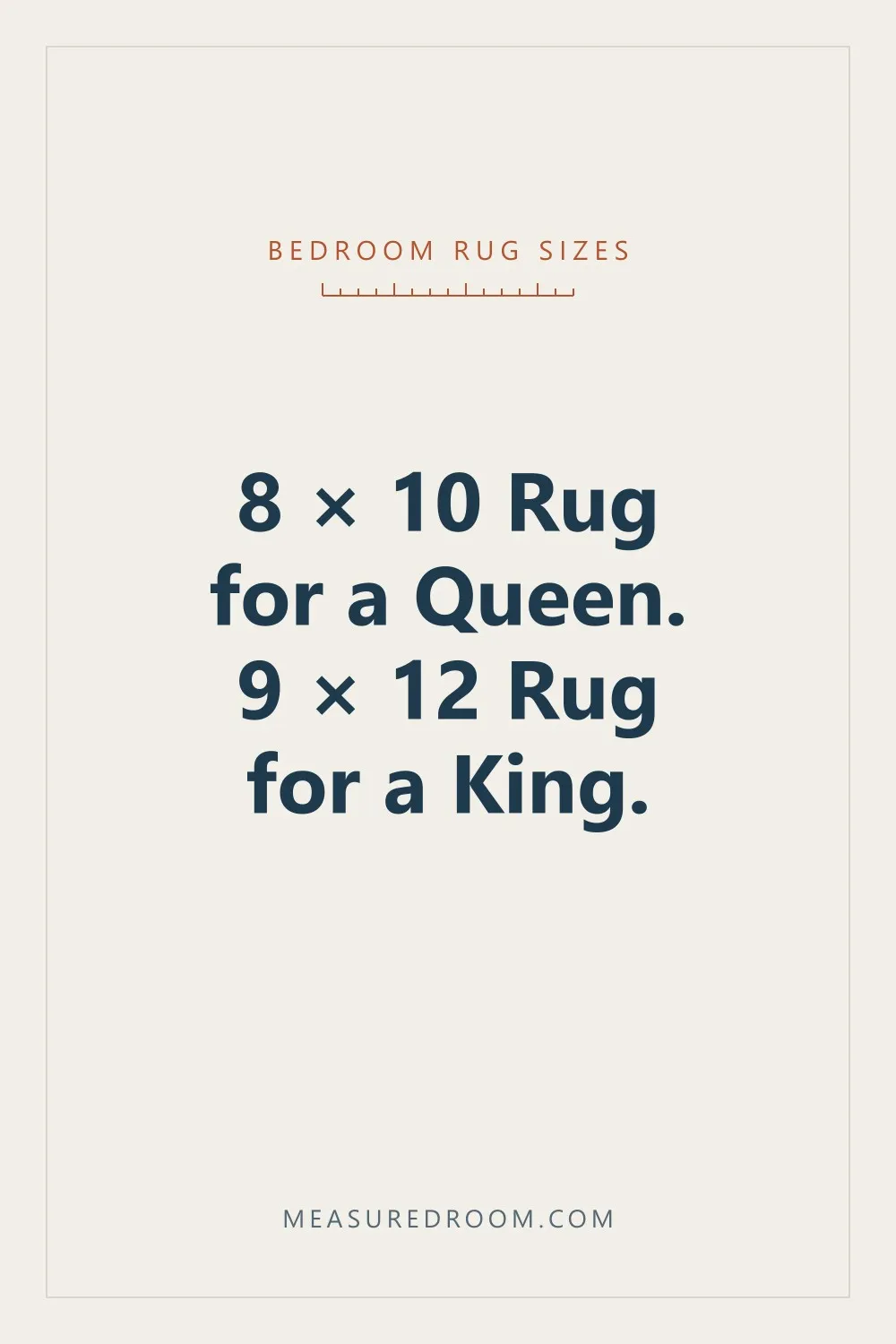
The beds are 83 in long whichever size you buy, so the foot is never the problem. The width is. If you take one thing away: an 8 × 10 for a queen, a 9 × 12 for a king, and a cut rug when the king’s room is too narrow for the 9 × 12. For what sits beside the bed, see nightstand height, and for the walkway around it, bedroom layouts.