Desk Depth and Monitor Distance in a Small Room
DisclosureThis page contains affiliate links. If you buy through them, we may earn a commission at no extra cost to you.
Desk depth is sold as a comfort feature: deeper is better, 30 in is standard, 24 in is for people with no room. That gets it backwards. What you need from a desk is enough distance between your eyes and the screen, and the desk is only one of three ways to get it — the cheapest of which takes no floor at all.
In a room where the desk shares space with a bed, six inches of depth is not a preference. It is the walkway.
The number you are actually buying
Comfortable viewing distance for a desktop monitor starts at about arm’s length and grows with the screen:
| Monitor | Comfortable distance, eyes to screen |
|---|---|
| 24 in | 20–28 in |
| 27 in | 24–32 in |
| 32 in | 30–40 in |
| Two 24 in, angled | 24–32 in |
| Laptop, screen only | 18–24 in |
Now take that apart on the desk. Your eyes sit roughly 8 in behind the front edge — closer than people think, because you lean. A conventional monitor stand puts the screen about 8–10 in forward of the back edge, feet and all.
So on a 30 in desk against a wall, the eye-to-screen distance is roughly 30 − 10 + 8 = 28 in. On a 24 in desk it is 22 in. That is the whole argument for the deeper desk, and it is worth exactly six inches.
The monitor arm is the cheap way to buy those six inches
A monitor arm clamps to the back edge and holds the screen with no base, which recovers most of the stand’s footprint and lets the panel sit right at the wall. On a 24 in desk that puts the screen about 4 in from the wall, which lands the viewing distance where a 30 in desk with a stand would have had it.
It costs roughly what a desk lamp costs, takes no floor, and gives back the desk surface the stand was standing on. If the room is tight, buy the arm before you buy the deeper desk — the arm is the only option here that improves both numbers at once.
The second cheap trick: a corner. A monitor in the corner of an L-shaped or corner desk sits on the diagonal, which is longer than either side. The diagonal of a 24 in corner is 34 in.
What the depth costs on the floor
Here is the part the desk listing does not show. A 9 ft × 10 ft bedroom that also has to be an office: a twin bed on the far wall, a wardrobe, a 60 in desk against the top wall, and the chair drawn where it sits when someone is pushed back from the desk. Only the desk depth changes between the two plans.
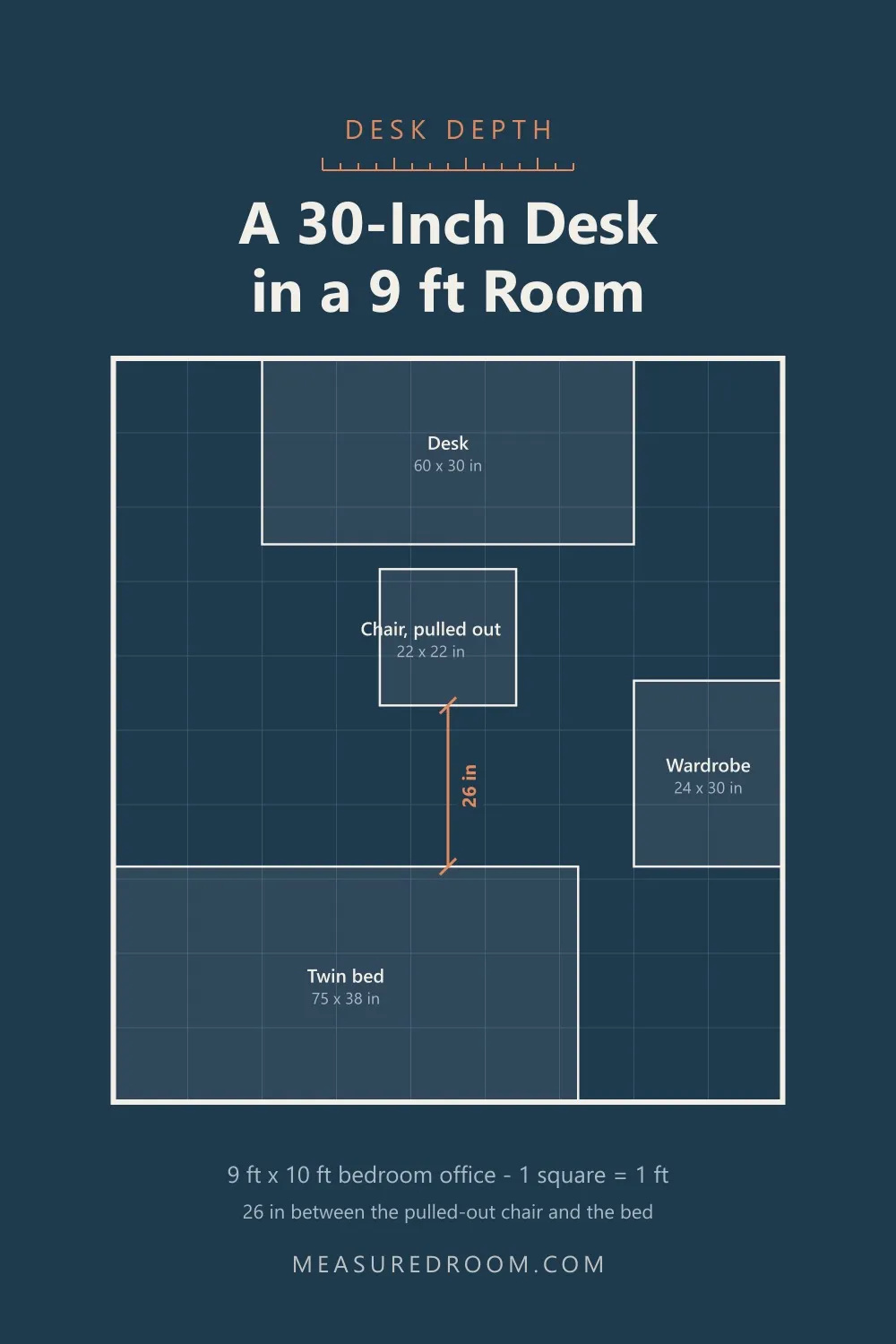
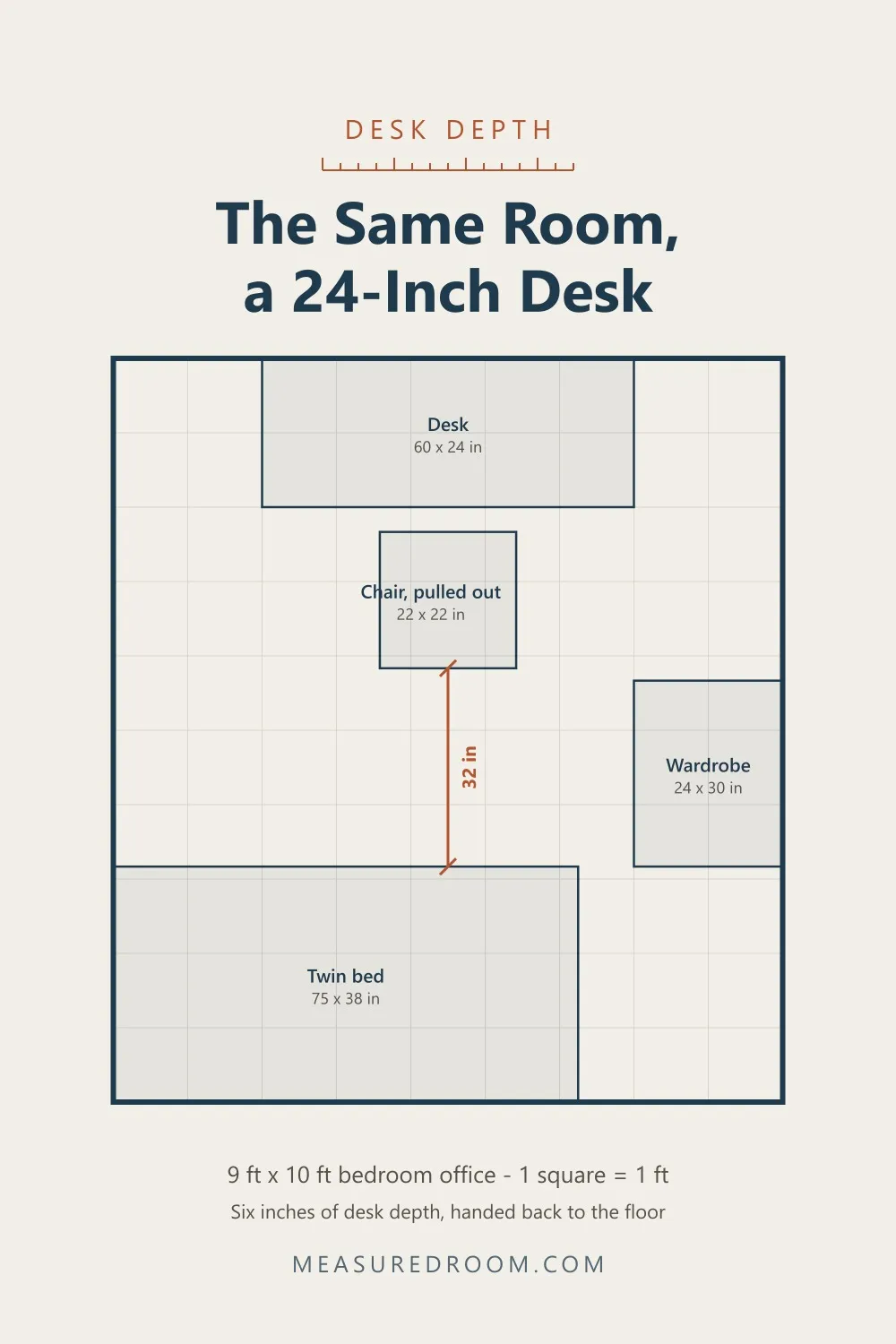
Measured off the drawings, not estimated by eye:
| 30 in desk | 24 in desk | |
|---|---|---|
| Chair to the bed | 26 in | 32 in |
| Floor left open | 49 sq ft | 52 sq ft |
| Eye-to-screen, monitor on a stand | 28 in | 22 in |
| Eye-to-screen, monitor on an arm | 34 in | 28 in |
Read the last two rows together with the first. The 24 in desk with an arm matches the 30 in desk with a stand on viewing distance — 28 in either way — and hands back six inches of walkway while doing it. Six inches of floor, for free, is the whole decision.
Twenty-six inches, in the first plan, is under the 30 in a person needs to get out of a chair and turn. It is the distance at which you edge sideways past your own chair every time you leave the room.
The other clearance: behind the chair
A desk chair needs about 36 in from the desk edge to push back and stand up, and 48 in if someone else has to walk behind you while you are sitting there. In a shared bedroom, the 48 in version usually does not exist, and that is fine — it just means the desk goes where nobody has to pass behind it, which is a wall, not the middle of a room.
Desk height is the one dimension with no argument: 28–30 in is standard, seated elbows want to land level with the desktop, and everything that varies is handled by the chair rather than the desk.
Before you buy
Four measurements, in this order: the wall you want the desk on, the distance from that wall to the nearest obstacle, the monitor you already own, and the depth of its stand.
If the second number is under 60 in, you are shopping for a shallow desk and a monitor arm, not a deep desk. The studio layouts show the same trade at whole-room scale, and if the desk has to come apart when you move, the renters’ furniture guide covers what “flat pack” actually means for a move.
Burrow publishes desk depth and height separately on its product pages, which is the minimum you need here. Nobody publishes the number that matters most — how far forward your particular monitor’s feet sit — so measure that one at home with a tape before you decide a desk is too shallow.
The short version
You are not buying desk depth. You are buying the distance between your eyes and the screen, and a monitor arm buys as much of it as six inches of desk does, for less money and no floor at all.
In a room under ten feet across, take the shallow desk, put the screen on an arm, and spend the six inches you saved on the walkway behind the chair.